Enhanced Fetal Arrhythmia Classification by Non-invasive ECG Using Cross Domain Feature and Spatial Differences Windows Information
Objective
To develop a cross-domain feature extraction and classification method for accurate fetal arrhythmia detection using NI-FECG, enhancing prenatal diagnosis and screening effectiveness.
Abstract
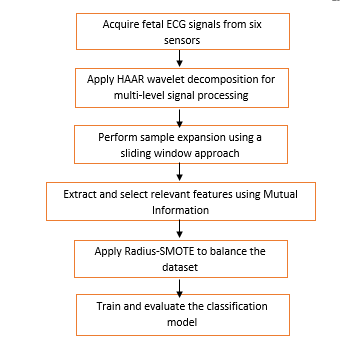
Fetal arrhythmia refers to an abnormal heart rhythm in a fetus, characterized by irregular, too fast (tachycardia), or too slow (bradycardia) heartbeats. Diagnosis is typically made using ultrasound or noninvasive fetal electrocardiography (NI-FECG), which monitors the electrical activity of the fetal heart. Accurate detection and management are crucial, as severe arrhythmias may lead to complications that affect the fetus's health during pregnancy and delivery. This study aims to develop an effective screening method for detecting arrhythmia (ARR) to aid physicians in diagnosing potential heart disease in fetal during pregnancy. This study presents a new cross-domain feature extraction method that incorporates temporal relationships between consecutive windows, improving feature representation by examining the correlation between neighboring windows. First, the original waveform signals from six sensors were transformed into a multi-level decomposition using the HAAR wavelet. Subsequently, a sample expansion was applied using a various-sized window sliding approach to each ARR and normal signal. Second, feature selection was implemented to reduce data dimensionality by selecting features highly relevant to the class labels. Finally, we applied oversampling techniques to address the issue of imbalanced data. Based on the results of an indepth experimental analysis, it was found that the application of window sampling for data expansion produced favorable outcomes, particularly at a window size of 500. The combination of dimensionality reduction using Mutual Information and oversampling with the Radius-SMOTE method achieved the highest performance, yielding an accuracy of 96.5%, precision of 95.2%, recall of 96.3%, and an F1-measure of 96.2%, while reducing the feature dimensionality to 100. Moreover, the proposed method demonstrated improved performance compared to state-of-the-art approaches. With further development, this method is expected to serve as a foundational model for the advancement of diagnostic tools for physicians.
Keywords: Arrhythmia, Non-invasive fetal electrocardiography, Cross-domain feature extraction, Selection feature, Oversampling dataNOTE: Without the concern of our team, please don't submit to the college. This Abstract varies based on student requirements.
Block Diagram
Specifications
Software: Matlab 2022b or above
Hardware:
Operating Systems:
- Windows 10
- Windows 7 Service Pack 1
- Windows Server 2019
- Windows Server 2016
Processors:
Minimum: Any Intel or AMD x86-64 processor
Recommended: Any Intel or AMD x86-64 processor with four logical cores and AVX2 instruction set support
Disk:
Minimum: 2.9 GB of HDD space for MATLAB only, 5-8 GB for a typical installation
Recommended: An SSD is recommended A full installation of all MathWorks products may take up to 29 GB of disk space
RAM:
Minimum: 4 GB
Recommended: 8 GB
Learning Outcomes
· Introduction to Matlab
· What is EISPACK & LINPACK
· How to start with MATLAB
· About Matlab language
· Matlab coding skills
· About tools & libraries
· Application Program Interface in Matlab
· About Matlab desktop
· How to use Matlab editor to create M-Files
· Features of Matlab
· Basics on Matlab
· What is Signal Processing?
· About Signal Processing
· Introduction to Signal Processing
· How analog and digital signal is formed
· Importing the signal via signal acquisition tools
· Analyzing and manipulation of signals.
· Phases of signal processing:
· Acquisition
· Signal enhancement
· Signal restoration
· Medical Signal Processing
· Medical Signal Analysis
· Medical Signal Diagnosis
· Filtering techniques
· Machine Learning Algorithms
· Deep Learning Algorithms etc.
· How to extend our work to another real time applications
· Project development Skills
o Problem analyzing skills
o Problem solving skills
o Creativity and imaginary skills
o Programming skills
o Deployment
o Testing skills
o Debugging skills
o Project presentation skills
o Thesis writing skills
Demo Video


Request for Video
 Paper Publishing
Request Call Back
Would you like to receive a free callback now?
Choose the best time for callback:
Leave your message and we will contact you as soon as possible

6-2-85/B, Old Maternity Hospital Road, Thyagaraja Nagar, Tirupati, Andhra Pradesh – 517501
+91 9030333433
+91 9393939065
0877-2261612

Disclaimer - Takeoff Edu Group Projects are not associated or affiliated with IEEE in any way. The IEEE Projects mentioned here are mentioned in the context of student projects, whose ideas are derived from IEEE publications, not projects of or by IEEE.

