Enhanced Bone Fracture Prediction Using Transfer Learning and YOLOv8 Deep Learning Models
Objective
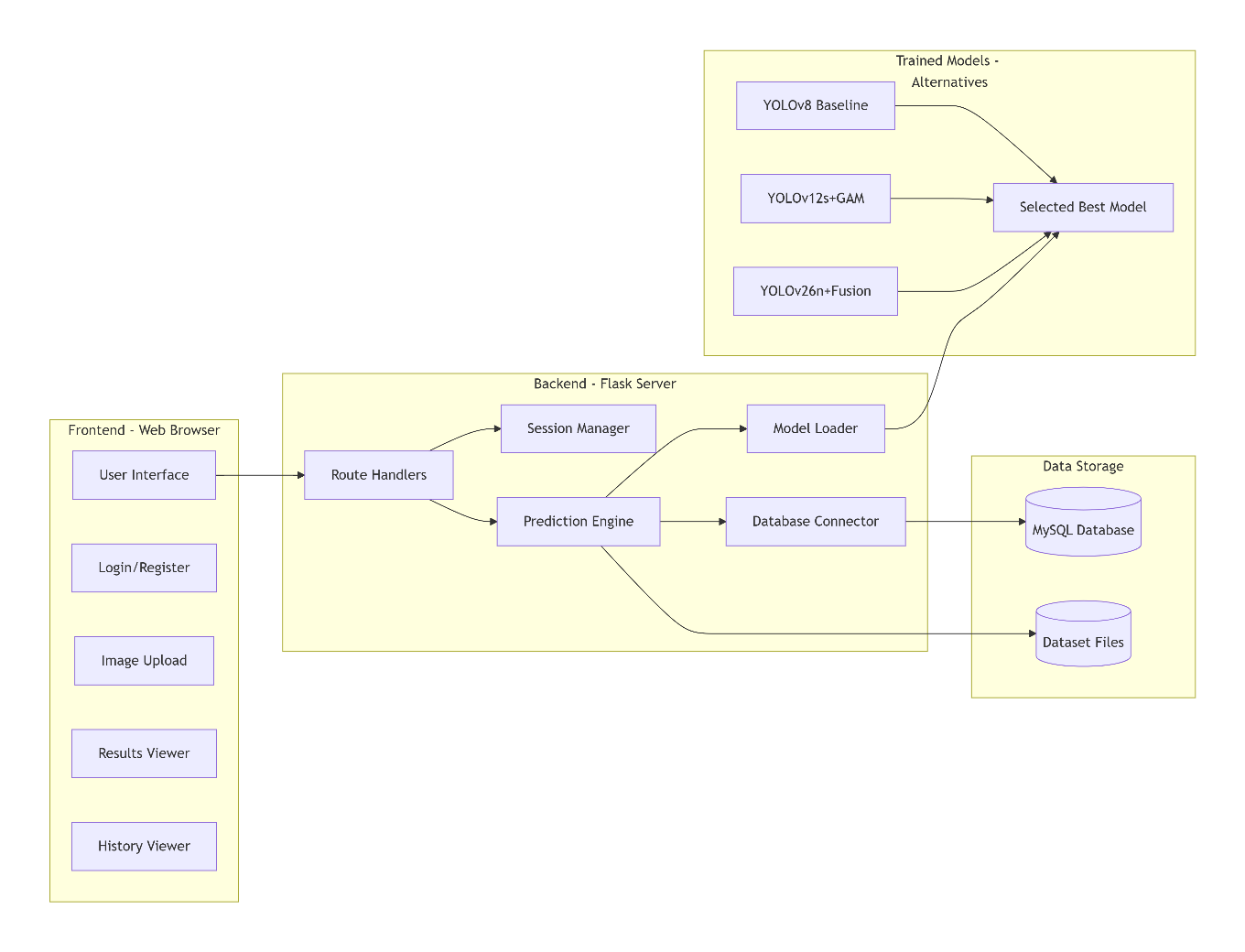
BoneTrack AI is a deep learning system for automated bone fracture detection using three enhanced YOLO architectures: YOLOv8 baseline, YOLOv12s with a Global Attention Module, and YOLOv26n with multi-scale feature fusion. Trained on fracture/non-fracture images via transfer learning, the best model deploys as a web application, offering rapid, interpretable visual predictions to assist clinicians.
Abstract
Bone fractures are among the most common injuries encountered in clinical practice, yet their accurate identification in medical imagery remains challenging due to variations in image quality, bone morphology, and fracture subtlety. This work presents a deep learning–based approach for automated bone fracture detection using three enhanced YOLO architectures. The proposed system, BoneTrack AI, leverages transfer learning from large-scale object detection datasets to improve generalization on medical images. Three models are developed and compared: a standard YOLOv8 baseline, a YOLOv12s variant augmented with a Global Attention Module that sequentially recalibrates channel and spatial features, and a YOLOv26n model incorporating a learnable multi‑scale fusion block to adaptively combine pyramidal feature representations. All models are trained on a curated dataset containing two categories—fracture and non‑fracture—enabling binary classification and localization. Extensive evaluation demonstrates the strengths of attention and fusion mechanisms for focusing on diagnostically relevant regions. The best‑performing model is deployed as the backend of a web‑based application, allowing users to upload medical images and receive immediate fracture predictions with visual overlays. This integrated solution illustrates how modern object detection architectures, combined with targeted architectural enhancements, can assist clinicians by providing rapid, interpretable second opinions.
Keywords: Bone fracture detection, YOLOv8, transfer learning, attention mechanism, multi‑scale feature fusion, medical image analysis
NOTE: Without the concern of our team, please don't submit to the college. This Abstract varies based on student requirements.
Block Diagram
Specifications
1. SOFTWARE REQUIREMENS
Operating System : Windows 7/8/10
Server-side Script : HTML, CSS, Bootstrap & JS
Programming Language : Python
Libraries : Flask, Pandas, Sklearn,Pytorch,Ultralytics NumPy, Seaborn, Matplotlib,pillow, Torch
IDE/Workbench : VSCode
Technology : Python 3.8+
Server Deployment : Xampp Server
Database : MySQL
2. HARDWARE REQUIREMENTS
Processor - I5/Intel Processor
RAM - 8GB+ (min)
Hard Disk - 128 GB+
Key Board - Standard Windows Keyboard
Mouse - Two or Three Button Mouse
Monitor - Any


 Paper Publishing

Request Call Back
Would you like to receive a free callback now?
Choose the best time for callback:
Leave your message and we will contact you as soon as possible

6-2-85/B, Old Maternity Hospital Road, Thyagaraja Nagar, Tirupati, Andhra Pradesh – 517501
+91 9030333433
+91 9393939065
0877-2261612

Disclaimer - Takeoff Edu Group Projects are not associated or affiliated with IEEE in any way. The IEEE Projects mentioned here are mentioned in the context of student projects, whose ideas are derived from IEEE publications, not projects of or by IEEE.

