Energy-efficient D2D Communication Based Retransmission Scheme for Reliable Multicast in Wireless Cellular Network
Abstract
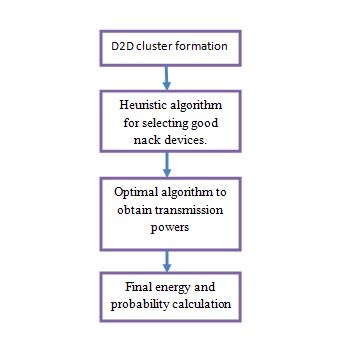
In this work we are concentrating on Energy-efficient D2D Communication Based Re-transmission Scheme for Reliable Multicast in Wireless Cellular Network. In the traditional reliable multicast schemes of wireless cellular network, base station (BS) repeatedly transmits the same packet until it is received by all receivers. The uses of device-to-device (D2D) communication can greatly offload the traffic of BS. This paper considers D2D communication based multicast from BS to a cluster of devices which are close to one another (e.g., in the same building).
So far, the efficient D2D re-transmission scheme available is to associate each NACK-device (which did not correctly receive the data from BS) to some near ACK-device (which correctly received the data) for forming sub clusters, and let ACK-devices re-transmit the data to their respective associated NACK-devices in the FDMA mode by using multiple channels, aiming to minimize the time-frequency resource cost. Noticing that the total available channels are very limited and the devices' energy is a very precious resource. In this paper, we first present the sub cluster-based single-channel D2D re-transmission way where the ACK-devices use the same channel in the TDMA mode.
Then, aiming to minimize the total energy consumption of re-transmitters, we formulate the joint optimization of NACK-devices' association and re-transmitters transmission powers to be a mixed integer programming problem. Finally, we propose an efficient algorithm for this problem to find a good association pattern and transmission powers. Simulation results show that, using D2D communication greatly reduces multicast traf_c load of BS. Moreover, compared to its counterparts with a fixed number of re-transmitters, our re-transmission scheme greatly reduces the total energy consumption of re-transmitters.
NOTE: Without the concern of our team, please don't submit to the college. This Abstract varies based on student requirements.
Block Diagram
Specifications
Software: Matlab 2018a or above
Hardware:
Operating Systems:
- Windows 10
- Windows 7 Service Pack 1
- Windows Server 2019
- Windows Server 2016
Processors:
Minimum: Any Intel or AMD x86-64 processor
Recommended: Any Intel or AMD x86-64 processor with four logical cores and AVX2 instruction set support
Disk:
Minimum: 2.9 GB of HDD space for MATLAB only, 5-8 GB for a typical installation
Recommended: An SSD is recommended A full installation of all Math Works products may take up to 29 GB of disk space
RAM:
Minimum: 4 GB
Recommended: 8 GB

Contact Us
- info@takeoffprojects.com
- +91 9030333433, +91 9393939065


 Paper Publishing

Request Call Back
Would you like to receive a free callback now?
Choose the best time for callback:
Leave your message and we will contact you as soon as possible

6-2-85/B, Old Maternity Hospital Road, Thyagaraja Nagar, Tirupati, Andhra Pradesh – 517501
+91 9030333433
+91 9393939065
0877-2261612

Disclaimer - Takeoff Edu Group Projects are not associated or affiliated with IEEE in any way. The IEEE Projects mentioned here are mentioned in the context of student projects, whose ideas are derived from IEEE publications, not projects of or by IEEE.

