END-TO-END SPEECH EMOTION RECOGNITION WITH GENDER INFORMATION
Objective
The objective of this project is to design a robust Speech Emotion Recognition (SER) system that accurately detects emotions in speech using raw audio data while incorporating speaker gender information to enhance recognition accuracy. This system aims to overcome the limitations of traditional SER models, which depend heavily on pre-selected acoustic features and often overlook subtle emotional cues. By utilizing a Residual Convolutional Neural Network (R-CNN), the model will directly extract meaningful emotional patterns from the raw speech signal, reducing the need for manual feature selection and capturing nuanced emotional expressions.
Abstract
ABSTRACT
Recent advancements in speech emotion recognition (SER) have primarily centered on effective feature selection from acoustic data. This study introduces a novel SER algorithm that leverages raw speech data combined with gender information to enhance recognition accuracy, eliminating the need for manually selected acoustic features. Our approach integrates a Residual Convolutional Neural Network (R-CNN) model to detect emotions directly from raw speech signals and a Random Forest classifier to determine speaker gender. The R-CNN model processes the raw audio, extracting emotional cues for accurate classification without relying on pre-selected acoustic features, thus capturing subtle emotion-driven nuances that traditional methods may overlook. Simultaneously, the Random Forest classifier processes speech data to identify the speaker’s gender, providing contextual information that strengthens the emotion recognition process. Evaluated across three public datasets in multiple languages, the proposed model demonstrates a notable improvement in accuracy and interpretability by leveraging both emotion and gender information. This approach highlights the benefits of a dual-model framework that combines deep learning and ensemble methods, pushing the boundaries of affective computing through a more holistic understanding of speech data.
Keywords: Affective Computing, Speech Emotion Recognition, Gender Classifier, Deep Learning, Interpretability, Random Forest, Residual CNN.
NOTE: Without the concern of our team, please don't submit to the college. This Abstract varies based on student requirements.
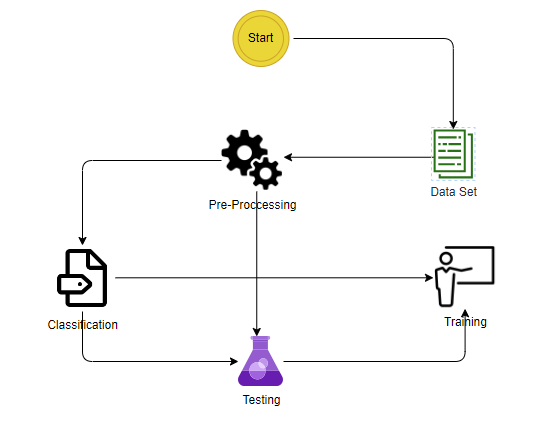
Block Diagram
Specifications
1. SOFTWARE REQUIREMENS
Operating System : Windows 7/8/10
Server side Script : HTML, CSS, Bootstrap & JS
Programming Language : Python
Libraries :Flask, Pandas, Torch, Keras, Sklearn, Numpy , Seaborn
IDE/Workbench : VSCode
Technology : Python 3.6+
Server Deployment : Xampp Server
Database : MySQL
2. HARDWARE REQUIREMENTS
Processor - I3/Intel Processor
RAM - 8GB (min)
Hard Disk - 128 GB
Key Board - Standard Windows Keyboard
Mouse - Two or Three Button Mouse
Monitor - Any


 Paper Publishing

Request Call Back
Would you like to receive a free callback now?
Choose the best time for callback:
Leave your message and we will contact you as soon as possible

6-2-85/B, Old Maternity Hospital Road, Thyagaraja Nagar, Tirupati, Andhra Pradesh – 517501
+91 9030333433
+91 9393939065
0877-2261612

Disclaimer - Takeoff Edu Group Projects are not associated or affiliated with IEEE in any way. The IEEE Projects mentioned here are mentioned in the context of student projects, whose ideas are derived from IEEE publications, not projects of or by IEEE.

