Empowering Glioma Prognosis with Transparent machine learning and Interpretatve insights using explainable AI
Objective
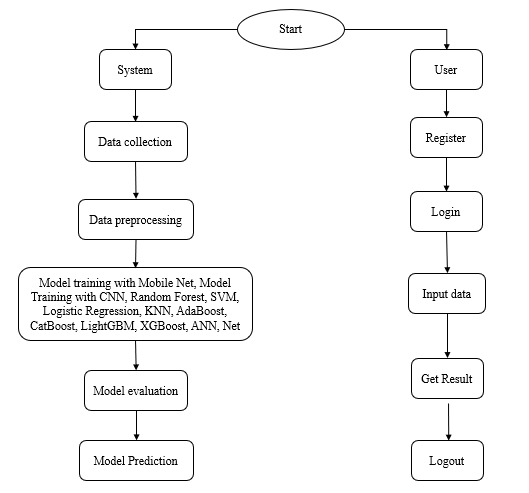
The objective of this project is to develop an accurate and interpretable classification system for golioma grades, distinguishing between Low-Grade Gliomas (LGG) and Glioblastoma Multiforme (GBM). Utilizing a comprehensive ensemble of machine learning algorithms, including Random Forest, Decision Trees, Logistic Regression, KNN, Adaboost, SVM, CatBoost, LGBM, and XGBoost, alongside deep learning models such as ANN and CNN, the project aims to enhance classification performance. Additionally, by integrating Explainable AI (XAI) techniques like SHAP, the project seeks to provide transparent insights into model predictions, facilitating clinical trust and adoption of AI-driven glioma prognosis tools.
Abstract
Gliomas are among the most common and lethal types of brain tumors, with significant implications for patient prognosis and treatment strategies. Accurate and transparent classification of glioma grades is crucial for effective clinical decision-making. This study aims to empower glioma prognosis by employing a robust ensemble of machine learning algorithms and deep learning techniques, augmented with interpretative insights derived from Explainable AI (XAI) strategies. In this research, we classify glioma grades into two categories: Low-Grade Gliomas (LGG) and Glioblastoma Multiforme (GBM). The classification models implemented include Random Forest, Decision Trees, Logistic Regression, K-Nearest Neighbors (KNN), Adaboost, Support Vector Machine (SVM), CatBoost, LightGBM (LGBM), and XGBoost, alongside deep learning models such as Artificial Neural Networks (ANN) and Convolutional Neural Networks (CNN). To enhance the interpretability of these models, we integrate four alternative XAI strategies, focusing on the SHapley Additive exPlanations (SHAP) algorithm. SHAP provides a detailed understanding of feature importance and model predictions, ensuring that the classification process remains transparent and comprehensible to clinicians. Through comprehensive experimentation and evaluation, this study demonstrates the potential of combining advanced machine learning techniques with XAI to improve glioma grade classification accuracy while maintaining model transparency. The findings underscore the importance of explainability in clinical applications, fostering trust and facilitating the adoption of AI-driven solutions in medical practice. This approach not only aids in precise glioma prognosis but also sets a benchmark for future research in the intersection of machine learning and healthcare.
Keywords: Glioma prognosis, machine learning, deep learning, explainable AI, SHAP, glioma grade classification, LGG, GBM.
NOTE: Without the concern of our team, please don't submit to the college. This Abstract varies based on student requirements.
Block Diagram
Specifications
Hardware Requirements
Processor - I3/Intel Processor
Hard Disk - 160GB
Key Board - Standard Windows Keyboard
Mouse - Two or Three Button Mouse
Monitor - SVGA
RAM - 8GB
Software Requirements:
Operating System : Windows 7/8/10/11
Server side Script : HTML, CSS, Bootstrap & JS
Programming Language : Python
Libraries : Flask, Pandas, Mysql.connector, Os, Smtplib, Numpy
IDE/Workbench : PyCharm or VS Code
Technology : Python 3.6+
Server Deployment : Xampp Server
Database : MySQL


 Paper Publishing

Request Call Back
Would you like to receive a free callback now?
Choose the best time for callback:
Leave your message and we will contact you as soon as possible

6-2-85/B, Old Maternity Hospital Road, Thyagaraja Nagar, Tirupati, Andhra Pradesh – 517501
+91 9030333433
+91 9393939065
0877-2261612

Disclaimer - Takeoff Edu Group Projects are not associated or affiliated with IEEE in any way. The IEEE Projects mentioned here are mentioned in the context of student projects, whose ideas are derived from IEEE publications, not projects of or by IEEE.

