Employee Turnover Prediction Model Based on Feature Selection and Imbalanced Data Handling
Objective
This study predicts employee turnover using the Kaggle HR dataset. A machine learning pipeline, including preprocessing, EDA, feature selection (correlation matrix, Chi-Square, RFE), and class imbalance handling (SMOTE, GAN), was applied. Five models were evaluated: SVM + CNN, Stacking Classifier, LightGBM, CatBoost, and a hybrid SVM + CNN model. The hybrid model, trained on GAN-balanced data with RFE features, achieved the best performance with 98% accuracy, 92% recall, and 95% F1-score. The approach was also applied to the IBM HR dataset, showing robust performance across datasets.
Abstract
Employee turnover prediction is vital for organizations aiming to retain talent and reduce operational costs. In this study, we utilized the Kaggle HR dataset to predict employee turnover through a comprehensive machine learning pipeline, including preprocessing, exploratory data analysis (EDA), and feature selection using correlation matrix analysis, Chi-Square tests, and Recursive Feature Elimination (RFE). To address class imbalance, we applied SMOTE and GAN-based oversampling techniques. We evaluated five models: SVM with CNN, Stacking Classifier, LightGBM, CatBoost, and a hybrid SVM + CNN model, assessing their performance using recall, F1-score, Cohen’s Kappa, ROC-AUC, PR-AUC, and confusion matrix. Results revealed that the hybrid SVM + CNN model, trained on GAN-balanced data and using RFE-selected features, achieved the best performance with an accuracy of 0.98, precision of 0.98, recall of 0.92, F1-score of 0.95, and Cohen’s Kappa of 0.94. The Stacking Classifier, LightGBM, and CatBoost also performed well, with results comparable to the hybrid model. The methodology was applied to the IBM HR dataset, where the same techniques improved minority class detection, demonstrating the robustness and generalizability of the framework across different datasets.
Keywords: Employee turnover prediction, human resource management, Kaggle HR dataset, machine learning, recursive feature elimination (RFE), SMOTE
NOTE: Without the concern of our team, please don't submit to the college. This Abstract varies based on student requirements.
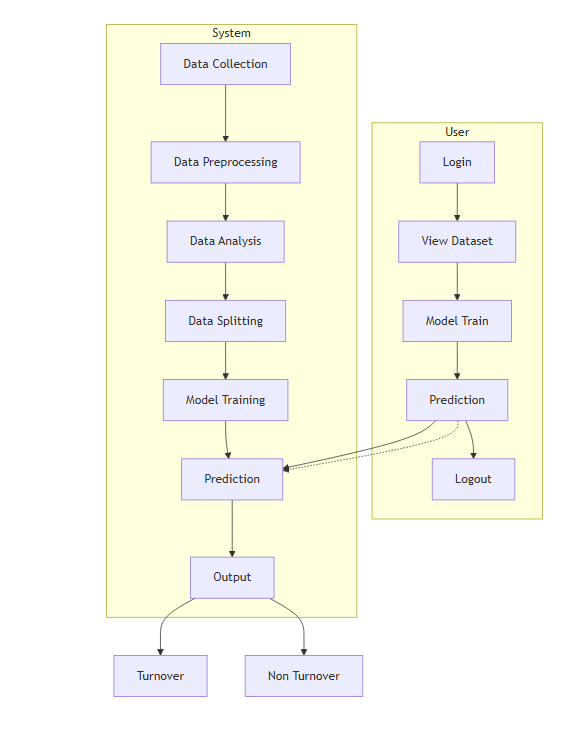
Block Diagram
Specifications
SOFTWARE REQUIREMENS
Operating System : Windows 7/8/10
Server side Script : HTML, CSS, Bootstrap & JS
Programming Language : Python
Libraries : Flask, Pandas, TensorFlow, Keras, Sklearn,Numpy , Seaborn,Mysql.connector
IDE/Workbench : VSCode
Server Deployment : Xampp Server
Database : SQLite
HARDWARE REQUIREMENTS
Processor - I3/Intel Processor
RAM - 8GB (min)
Hard Disk - 128 GB
Key Board - Standard Windows Keyboard
Mouse - Two or Three Button Mouse
Monitor - Any


 Paper Publishing

Request Call Back
Would you like to receive a free callback now?
Choose the best time for callback:
Leave your message and we will contact you as soon as possible

6-2-85/B, Old Maternity Hospital Road, Thyagaraja Nagar, Tirupati, Andhra Pradesh – 517501
+91 9030333433
+91 9393939065
0877-2261612

Disclaimer - Takeoff Edu Group Projects are not associated or affiliated with IEEE in any way. The IEEE Projects mentioned here are mentioned in the context of student projects, whose ideas are derived from IEEE publications, not projects of or by IEEE.

