Embedded-Based Real-Time Assistance and Safety System for Alzheimer’s Patients
Objective
The objective is to build an embedded system that offers real-time monitoring, tracking, and emergency alerts to ensure safety and provide assistance for Alzheimer’s patients.
Abstract
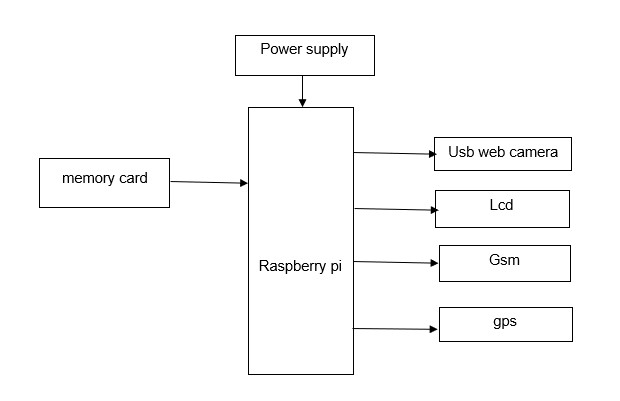
The Embedded-Based Real-Time Assistance and Safety System for Alzheimer’s Patients is designed to enhance patient safety, provide real-time health monitoring, and assist caregivers in emergency situations. The system integrates multiple embedded components controlled by a Raspberry Pi, serving as the central processing unit. A USB web camera continuously monitors the patient’s face and behavior patterns to detect symptoms associated with Alzheimer’s disease using machine learning or image recognition techniques. A GPS module provides continuous location tracking of the patient, while the GSM module sends automatic alert messages to caregivers or family members in case of abnormal activities, wandering, or emergency detection. An LCD display is used to show real-time system status and alerts, and a buzzer provides audible warnings for local alerts. The power supply ensures stable operation of all components. This system ensures patient safety by offering continuous monitoring, location tracking, and automated communication, thereby reducing caregiver burden and improving the quality of care for Alzheimer’s patients.
Keywords:
1. Alzheimer’s Monitoring
2. Raspberry Pi
3. GSM and GPS Tracking
4. Real-Time Assistance
5. Patient Safety System
NOTE: Without the concern of our team, please don't submit to the college. This Abstract varies based on student requirements.
Block Diagram
Specifications
Hardware components:
- Raspberry pi
- memory card
- Usb web camera
- Lcd
- Gsm
- Buzzer
- gps
- Power supply
- 12v Adapter
Software components:
- Raspbian os
- Python
Learning Outcomes
- Raspberry pi pin diagram and architecture
- How to install Raspberrypi / setup software
- Setting up and installation procedure for Raspberrypi
- Introduction to Raspberrypi environment / development setup
- Basic programming in Raspberrypi (Python)
- Basics of Embedded programming using Raspberrypi
- Basics of IoT platforms
- Working of power supply
- About Project Development Life Cycle:
- Planning and Requirement Gathering (software, tools, hardware components, etc.)
- Schematic preparation
- Code development and debugging
- Hardware development and debugging
- Development of the project and output testing
- Practical exposure to:
- Hardware and software tools
- Solution providing for real-time problems
- Working with team/individual
- Work on creative ideas
- Skills developed:
- Project development skills
- Problem analyzing skills
- Problem solving skills
- Creativity and imaginative skills
- Programming skills
- Deployment
- Testing skills
- Debugging skills
- Project presentation skills
- Thesis writing skills


 Paper Publishing

Request Call Back
Would you like to receive a free callback now?
Choose the best time for callback:
Leave your message and we will contact you as soon as possible

6-2-85/B, Old Maternity Hospital Road, Thyagaraja Nagar, Tirupati, Andhra Pradesh – 517501
+91 9030333433
+91 9393939065
0877-2261612

Disclaimer - Takeoff Edu Group Projects are not associated or affiliated with IEEE in any way. The IEEE Projects mentioned here are mentioned in the context of student projects, whose ideas are derived from IEEE publications, not projects of or by IEEE.

