El nino La nina
Objective
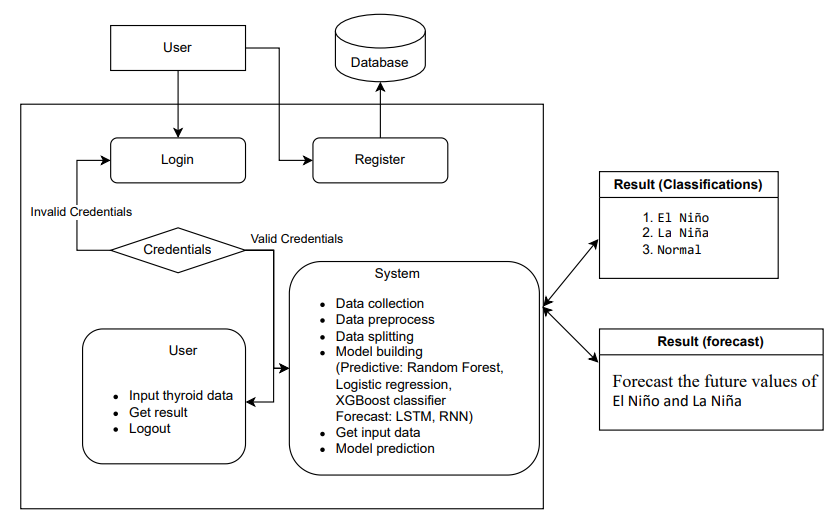
To classify ENSO phases (El Niño, La Niña, Normal) using machine learning and forecast future ONI values with deep learning models, improving climate prediction and preparedness for global weather impacts.
Abstract
El Niño and La Niña are critical phases of the El Niño-Southern Oscillation (ENSO), significantly impacting global climate patterns. This project aims to develop a machine learning-based predictive model and a deep learning forecasting model to understand and anticipate ENSO events. For the predictive model, Random Forest, Logistic Regression, and XGBoost classifiers are employed to classify climate conditions into El Niño or La Niña or Normal events using historical climate data. Additionally, Long Short-Term Memory (LSTM) and Recurrent Neural Network (RNN) models are used for time series forecasting of the Oceanic Niño Index (ONI) to predict future ENSO phases. The dataset used includes key oceanic and atmospheric variables, such as sea surface temperatures and pressure levels, obtained from historical ENSO records. The models are evaluated based on accuracy, precision, recall for classification, and RMSE and MAE for time series forecasting. The results demonstrate the effectiveness of machine learning and deep learning techniques in predicting and forecasting ENSO events, providing valuable insights for climate monitoring and forecasting.
Keywords: El Niño, La Niña, Oceanic Niño Index (ONI), El Niño-Southern Oscillation (ENSO).
NOTE: Without the concern of our team, please don't submit to the college. This Abstract varies based on student requirements.
Block Diagram
Specifications
H/W CONFIGURATION:
Processor - I3/Intel Processor
Hard Disk - 160GB
Key Board - Standard Windows Keyboard
Mouse - Two or Three Button Mouse
Monitor - SVGA
RAM - 8GB
S/W CONFIGURATION:
• Operating System : Windows 7/8/10
• Server side Script : HTML, CSS, Bootstrap & JS
• Programming Language : Python
• Libraries : Flask, Pandas, Mysql.connector, Os, Scikit-learn, Numpy
• IDE/Workbench : PyCharm
• Technology : Python 3.6+
• Server Deployment : Xampp Server


 Paper Publishing

Request Call Back
Would you like to receive a free callback now?
Choose the best time for callback:
Leave your message and we will contact you as soon as possible

6-2-85/B, Old Maternity Hospital Road, Thyagaraja Nagar, Tirupati, Andhra Pradesh – 517501
+91 9030333433
+91 9393939065
0877-2261612

Disclaimer - Takeoff Edu Group Projects are not associated or affiliated with IEEE in any way. The IEEE Projects mentioned here are mentioned in the context of student projects, whose ideas are derived from IEEE publications, not projects of or by IEEE.

