EffNet SVM A Hybrid Model for Diabetic Retinopathy Classification Using Retinal Fundus Images
Objective
The objective of this project is to develop an accurate and interpretable machine learning model for anemia prediction using medical and demographic data. By integrating explainable AI techniques such as LIME, SHAP, and PDP, the model aims to support clinical decision-making with transparent insights into feature importance and prediction logic for reliable healthcare outcomes.
Abstract
NOTE: Without the concern of our team, please don't submit to the college. This Abstract varies based on student requirements.
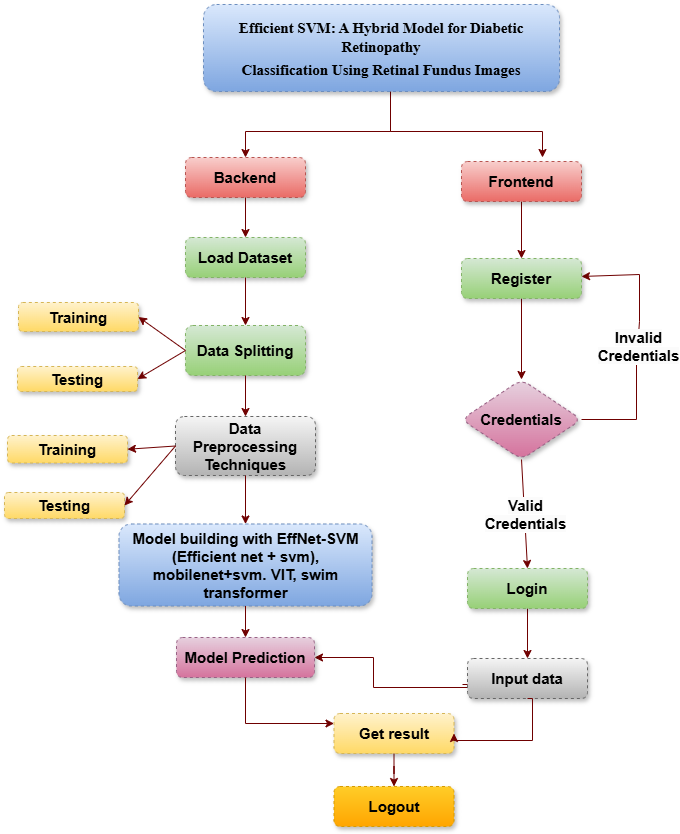
Block Diagram
Specifications
4.2 H/W CONFIGURATION:
u Processor - I3/Intel Processor
u Hard Disk -160 GB
u RAM - 8 GB
To implement and test the anemia prediction model effectively, the system requires a basic yet capable hardware setup that supports machine learning model development, training, and deployment. The selected configuration ensures smooth operation of the application, efficient memory management during model training, and seamless web interface responsiveness.
- Processor – Intel i3 or Equivalent:
The system uses an Intel Core i3 processor or any equivalent processor that supports multitasking and moderate computational workloads. This is sufficient for running machine learning training pipelines, executing model inference, and handling backend logic.
- Hard Disk – 160 GB:
A minimum of 160 GB of storage is required to install the operating system, development tools, libraries, and datasets. It also provides adequate space for temporary storage of model files, logs, and project backups.
- RAM – 8 GB:
With 8 GB of RAM, the system can efficiently handle machine learning model training on small to medium-sized datasets, run multiple processes, and support a local server environment without performance lags.
4.3 S/W CONFIGURATION:
u Operating System : Windows 7/8/10 .
u Server side Script : HTML, CSS & JS.
u IDE : Vscode
u Libraries Used : Numpy, Pandas,Sklearn,Tensorflow
u Technology : Python 3.6+.
The software configuration outlines the operating environment, tools, and libraries used to build and run the anemia prediction model. These tools are chosen for their compatibility, ease of use, and support for machine learning and explainable AI development.
- Operating System – Windows 7/8/10:
The application is developed to be compatible with modern Windows platforms,
ensuring flexibility for a wide range of users and systems.
- Server Side Script – HTML, CSS, JavaScript:
These web technologies are used to build the frontend of the application,
enabling user interactions for data input, results display, and explanation
visualization in a browser-based environment.
- IDE – Visual Studio Code (VSCode):
VSCode is the preferred integrated development environment due to its rich
extension ecosystem, Python support, version control integration, and ease of
debugging.
- Libraries Used – NumPy, Pandas, Scikit-learn, TensorFlow:
- NumPy and Pandas are used for data manipulation and preprocessing.
- Scikit-learn handles machine learning models such as Decision Tree, KNN, SVM, and ensemble classifiers.
- TensorFlow supports implementation of deep learning models like the Multilayer Perceptron (MLP).
- Technology
– Python 3.6+:
Python is the core programming language for backend logic, machine learning, and model training. Version 3.6 or above ensures compatibility with modern libraries and better performance optimizations.

Demo Video


Request for Video
 Paper Publishing
Request Call Back
Would you like to receive a free callback now?
Choose the best time for callback:
Leave your message and we will contact you as soon as possible

6-2-85/B, Old Maternity Hospital Road, Thyagaraja Nagar, Tirupati, Andhra Pradesh – 517501
+91 9030333433
+91 9393939065
0877-2261612

Disclaimer - Takeoff Edu Group Projects are not associated or affiliated with IEEE in any way. The IEEE Projects mentioned here are mentioned in the context of student projects, whose ideas are derived from IEEE publications, not projects of or by IEEE.

