Efficient XAI-Based Federated Learning Approach for Accurate Detection of False Data in Smart Grid
Objective
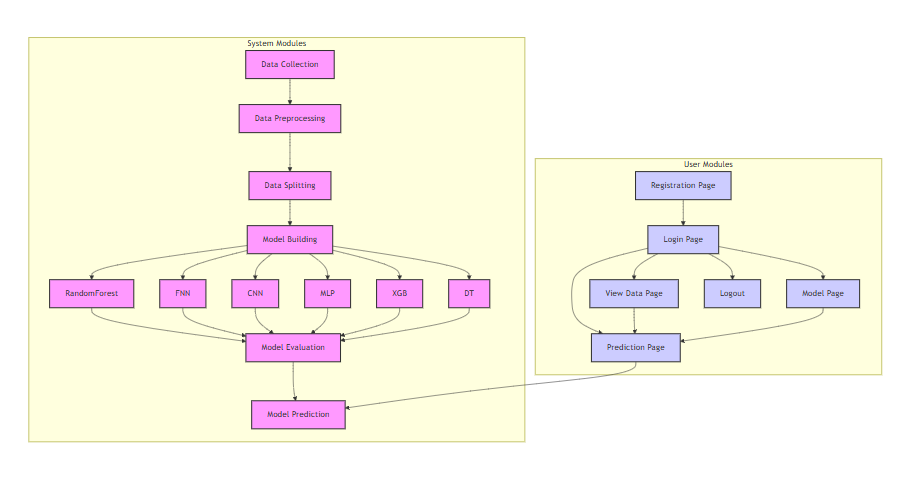
The project "Efficient XAI-Based Federated Learning Approach for Accurate Detection of False Data in Smart Grid" aims to enhance data integrity in smart grids by accurately detecting false or malicious data using explainable AI (XAI) and federated learning. The system leverages various machine learning models, including Decision Trees, Random Forest, and XGBoost, to detect anomalies in smart grid data such as power consumption or meter readings. It ensures privacy by applying federated learning, where models are trained across decentralized edge devices without data centralization. The system provides actionable suggestions for each identified anomaly type, improving security in smart grid operations.
Abstract
The rapid digitalization of smart grids has significantly improved energy distribution efficiency but has also exposed these systems to sophisticated cyber-attacks, particularly False Data Injection (FDI) attacks that manipulate measurement readings and compromise grid stability. This research proposes an Efficient XAI-Based Federated Learning Framework designed to detect false data with high accuracy while preserving user privacy and ensuring model interpretability. The system integrates a decentralized learning architecture where multiple local nodes collaboratively train machine learning models without sharing raw data, effectively reducing privacy risks and communication overhead. To enhance detection performance, advanced models such as Random Forest, Decision Tree, XGBoost, MLP, and a high-performing 1D CNN are employed and compared. Traditional ensemble models achieved perfect accuracy, while deep learning models, particularly the CNN, demonstrated exceptional capability in learning intricate attack patterns.
A key contribution of the proposed system is the incorporation of Explainable AI (XAI) techniques, enabling grid operators to understand feature importance, attack relevance, and decision paths behind each prediction. This transparency ensures trust, regulatory compliance, and improved situational awareness during attack mitigation. The federated learning module strengthens resilience by allowing real-time, collaborative anomaly detection across distributed grid devices. The system also features secure user authentication, streamlined data upload, and real-time prediction dashboards to support operational deployment. Overall, the framework provides a scalable, secure, and interpretable solution to enhance smart grid cyber-defense and ensure uninterrupted power delivery.
Keywords
Smart Grid, False Data Injection (FDI), Federated Learning, Explainable AI (XAI), Cybersecurity, Intrusion Detection, Machine Learning, Deep Learning, 1D CNN, Ensemble Models, Data Privacy, Attack Detection.
NOTE: Without the concern of our team, please don't submit to the college. This Abstract varies based on student requirements.
Block Diagram
Specifications
SOFTWARE REQUIREMENS
Operating System : Windows 7/8/10
Server side Script : HTML, CSS, Bootstrap & JS
Programming Language : Python
Libraries : Flask, Pandas, Torch, Keras, Sklearn, Numpy , Seaborn
IDE/Workbench : VSCode
Server Deployment : Xampp Server
Database : MySQL
HARDWARE REQUIREMENTS
Processor - I3/Intel Processor
RAM - 8GB (min)
Hard Disk - 128 GB
Key Board - Standard Windows Keyboard
Mouse - Two or Three Button Mouse
Monitor - Any


 Paper Publishing

Request Call Back
Would you like to receive a free callback now?
Choose the best time for callback:
Leave your message and we will contact you as soon as possible

6-2-85/B, Old Maternity Hospital Road, Thyagaraja Nagar, Tirupati, Andhra Pradesh – 517501
+91 9030333433
+91 9393939065
0877-2261612

Disclaimer - Takeoff Edu Group Projects are not associated or affiliated with IEEE in any way. The IEEE Projects mentioned here are mentioned in the context of student projects, whose ideas are derived from IEEE publications, not projects of or by IEEE.

