Efficient Design of Vedic Square Calculator Using Quantum Dot Cellular Automata QCA
Objective
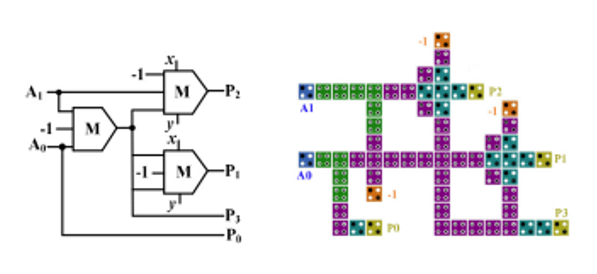
The main objective of this project is to design a coplanar QCA architecture for 2-bit Square calculator using Vedic mathematics.
Abstract
Abstract:
Vedic mathematics is now being realized to have a large potential in recent times which can be used to design digital circuits using the Vedic formulas. Vedic mathematics is a new trend in quantum-dot cellular automata (QCA) technology. However, an efficient coplanar design and a complete performance analysis are still desired. This brief presents the coplanar QCA architecture of a 2-bits square calculator (proposed design-1 or PD1) using the Vedic sutra ‘Urdhva Tiryagbhyam’. Furthermore, based on the E-shaped XOR gate and majority gate (MV) an optimized architecture (proposed design-2 or PD2) is presented. The PD2 architecture exhibits notable improvement compared to the previous architecture. The proposed PD2 requires 17%, 53%, and 25% fewer cells, smaller areas, and lower latency, respectively. Likewise, the extended design for 4-bit architecture (proposed design-3 or PD3) achieves 67%, 63%, and 62% superiority in cell count, covered area, and latency, respectively. Compare to the best previous design, the area-delay, QCA-specific, and energy-delay costs for PD2 (PD3) are lower by a factor of ∼10 (∼30), ∼71 (∼33), and ∼64 (∼83), respectively. Moreover, there is an improvement in terms of power dissipation as the QCA-based design PD2 (PD3) dissipates 1.41×10⁻⁶ mW (11.82×10⁻⁶ mW), whereas the similar type CMOS-based designs dissipate 2.29×10⁻² mW (48×10−2 mW), respectively. It is worth mentioning that the comprehensive performance analyses are carried out using the QCA Designer, QCA Designer-E tools.
Keywords: Multipliers, QCA circuits, QCA Designer, QCA Designer-E, square calculator, Vedic mathematics.
NOTE: Without the concern of our team, please don't submit to the college. This Abstract varies based on student requirements.
Block Diagram
Specifications
Specifications:
Software Requirements:
· QCA designer
Hardware Requirements:
· Microsoft® Windows XP
· Intel® Pentium® 4 processor or Pentium 4 equivalent with SSE support
· 512 MB RAM
· 100 MB of available disk space
Learning Outcomes
Learning Outcomes:
- Basics of Digital Electronics
- VLSI design Flow
- Introduction to Quantum dot cellular automata (QCA)
- Creating designs in QCA Designer tool.
- Introduction to Combinational circuits.
- Knowledge on multipliers.
- Knowledge on Vedic multipliers.
- Applications in real time
· QCA Designer for design and simulation
· Solution providing for real time problems
· Project Development Skills:
o Problem Analysis Skills
o Problem Solving Skills
o Logical Skills
o Designing Skills
o Testing Skills
o Debugging Skills
o Presentation Skills
o Thesis Writing Skills


 Paper Publishing

Request Call Back
Would you like to receive a free callback now?
Choose the best time for callback:
Leave your message and we will contact you as soon as possible

6-2-85/B, Old Maternity Hospital Road, Thyagaraja Nagar, Tirupati, Andhra Pradesh – 517501
+91 9030333433
+91 9393939065
0877-2261612

Disclaimer - Takeoff Edu Group Projects are not associated or affiliated with IEEE in any way. The IEEE Projects mentioned here are mentioned in the context of student projects, whose ideas are derived from IEEE publications, not projects of or by IEEE.

