Effects of rainfall on groundwater level based on usage population and climatic condition
Objective
The objective of this project is to investigate the impact of rainfall on groundwater levels, particularly in karst areas where groundwater responds rapidly to rainfall events. The study focuses on understanding the complex relationship between rainfall patterns, groundwater recharge, and fluctuations in groundwater levels, with consideration of other influencing factors such as population, water usage, and climate conditions. By analyzing the fractal behavior of rainfall and its effect on groundwater recharge, the project aims to develop a deeper understanding of groundwater dynamics. Using the Northern Huangqihai Basin as a case study, where both rainfall and groundwater exploitation significantly impact groundwater levels, the project quantifies the contributions of rainfall changes (22.08%) and groundwater exploitation (77.92%) to groundwater fluctuations. The project employs advanced machine learning algorithms, including Random Forest, Gradient Boost Regressor, and Linear Regression, to model and predict groundwater availability. Additionally, Explainable AI techniques like SHAP and LIME will be integrated to provide insights into the key factors driving groundwater level variations. The goal is to develop a predictive tool that aids in water resource management, ensuring sustainable groundwater availability.
Abstract
The project investigates the impact of rainfall on groundwater levels, considering factors such as population, water usage, and climate conditions. Rainfall significantly influences groundwater levels, particularly in karst areas, where the rapid response of groundwater to rainfall is observable. The study explores the fractal behavior of rainfall and its subsequent effects on groundwater recharge and level fluctuations. By analyzing the relationship between rainfall patterns, groundwater exploitation, and climate variables, this project aims to understand the processes driving groundwater dynamics. The Northern Huangqihai Basin, where both rainfall changes and groundwater extraction contribute to groundwater level fluctuations, serves as a case study. Here, rainfall changes account for 22.08%, while groundwater exploitation contributes 77.92%. The project employs advanced machine learning algorithms, including Random Forest, Gradient Boost Regressor, and Linear Regression, to model and predict groundwater availability. Additionally, techniques like Explainable AI (e.g., SHAP and LIME) will be used to interpret the model predictions and offer insights into the key factors influencing groundwater levels. Exploratory Data Analysis (EDA) will further inform the modeling process, uncovering patterns and relationships between rainfall, groundwater usage, and other climatic variables. The expected output is a predictive tool that estimates future groundwater availability, aiding in effective water resource management. This system will be developed with a Python backend, while the frontend will utilize HTML, CSS, and JavaScript for user interaction and visualization.
Keywords
Rainfall, Groundwater levels, Machine learning, Random Forest, Gradient Boost Regressor, Linear Regression, Explainable AI, SHAP, LIME, EDA, Water management, Hydrology.
NOTE: Without the concern of our team, please don't submit to the college. This Abstract varies based on student requirements.
Block Diagram
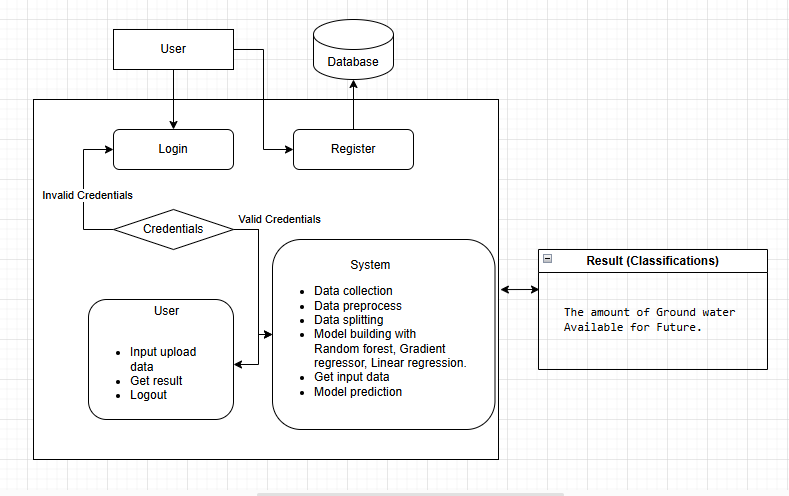
Specifications
H/W SPECIFICATIONS:
· Processor : I5/Intel Processor
· RAM : 8GB (min)
· Hard Disk : 128 GB
· Key Board : Standard Windows Keyboard
· Mouse : Two or Three Button Mouse
· Monitor : Any
S/W SPECIFICATIONS:
• Operating System : Windows 7+
• Server-side Script : Python 3.6+
• IDE : PyCharm / VSCode
• Libraries Used : Pandas, Numpy, Matplotlib, OS.


 Paper Publishing

Request Call Back
Would you like to receive a free callback now?
Choose the best time for callback:
Leave your message and we will contact you as soon as possible

6-2-85/B, Old Maternity Hospital Road, Thyagaraja Nagar, Tirupati, Andhra Pradesh – 517501
+91 9030333433
+91 9393939065
0877-2261612

Disclaimer - Takeoff Edu Group Projects are not associated or affiliated with IEEE in any way. The IEEE Projects mentioned here are mentioned in the context of student projects, whose ideas are derived from IEEE publications, not projects of or by IEEE.

