Effective Hardware Accelerator for 2D DCT or IDCT Using Improved Loeffler Architecture
Objective
The primary objective is to develop a hardware accelerator that efficiently computes the two-dimensional Discrete Cosine Transform (DCT) and its inverse (IDCT). The focus is on improving processing speed and reducing latency compared to existing implementations.
Abstract
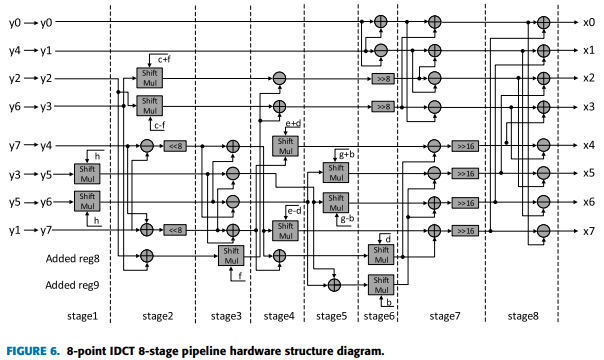
This paper proposes an effective hardware accelerator for 2D 8 × 8 discrete cosine transform (DCT) and inverse discrete cosine transform (IDCT) using an improved Loeffler architecture. The accelerator optimizes the data stream of the Loeffler 8-point 1D DCT/IDCT according to the characteristics of image and video processing. An 8-stage pipeline structure greatly improves the processing speed by reasonably dividing the number of clock cycles and simplifying the arithmetic operations in each cycle. The multiplication-free approximation of the DCT coefficients is implemented through adders and shifters, combined with both fixed-point and canonic signed digit (CSD) coding. In particular, the proposed fast parallel transposed matrix architecture achieves the function of row-column coefficient conversion with lower circuit complexity. The FPGA implementation of the proposed architecture uses a Virtex-7 XC7VX330T device, running at 288 MHz with a throughput of 558 M Pixel/sec, and a Full HD real-time frame rate of up to 269 fps. Only 33 cycles are required to complete the 8 × 8 blocks of 2D DCT/IDCT, which can be used as a high-performance hardware accelerator for image and video compression encoding.
Keywords— Loeffler algorithm, DCT, IDCT, parallel transpose, hardware accelerator.NOTE: Without the concern of our team, please don't submit to the college. This Abstract varies based on student requirements.
Block Diagram
Specifications
Software Requirements:
XILINIX VIVADO 2018.3, MATLAB 2022a
Hardware Requirements:
· Microsoft® Windows XP
· Intel® Pentium® 4 processor or Pentium 4 equivalent with SSE support
· 512 MB RAM
· 100 MB of available disk space
Learning Outcomes
- Basics of Digital Electronics
- VLSI design Flow
- Applications in real time
· VIVADO for design and simulation
· Solution providing for real time problems
· Project Development Skills:
o Problem Analysis Skills
o Problem Solving Skills
o Logical Skills
o Designing Skills
o Testing Skills
o Debugging Skills
o Presentation Skills
o Thesis Writing Skills
Demo Video


Request for Video
 Paper Publishing
Request Call Back
Would you like to receive a free callback now?
Choose the best time for callback:
Leave your message and we will contact you as soon as possible

6-2-85/B, Old Maternity Hospital Road, Thyagaraja Nagar, Tirupati, Andhra Pradesh – 517501
+91 9030333433
+91 9393939065
0877-2261612

Disclaimer - Takeoff Edu Group Projects are not associated or affiliated with IEEE in any way. The IEEE Projects mentioned here are mentioned in the context of student projects, whose ideas are derived from IEEE publications, not projects of or by IEEE.

