EEG-Based Emotion Detection Using Roberts Similarity and PSO Feature Selection
Objective
The objective of this project is to develop an advanced EEG-based emotion detection system using a combination of feature extraction techniques, machine learning, and deep learning models. By employing the Extra Trees Classifier for efficient feature extraction, the project aims to optimize the feature selection process through the PSO Feature Model Selector, incorporating KNN, SVM, and Random Forest. Additionally, the system integrates a CNN-LSTM hybrid model and Roberta Similarity to capture spatial and temporal dependencies in EEG signals, enhancing emotion recognition. This project seeks to improve emotion classification accuracy, robustness, and real-time processing, contributing to applications in healthcare and human-computer interaction.
Abstract
The detection of emotions through electroencephalography (EEG) signals has gained significant attention due to its potential applications in areas such as mental health diagnosis, human-computer interaction, and affective computing. This study proposes a novel emotion detection framework that integrates EEG-based signal processing with advanced machine learning and deep learning techniques. To enhance feature extraction, an Extra Trees Classifier is utilized to identify the most relevant features from EEG signals, which are then optimized using the PSOFeatureModelSelector. The feature selection model employs a combination of K-Nearest Neighbors (KNN), Support Vector Machine (SVM), and Random Forest (RF) to refine the selection process and improve classification accuracy.
For the classification task, the study leverages both traditional machine learning methods and deep learning architectures. A hybrid CNN-LSTM model is utilized, which effectively captures spatial and temporal dependencies in EEG data. Additionally, a Roberta Similarity-based approach is integrated to quantify the similarity between EEG signal patterns, improving the overall emotion classification process. The framework also explores the use of DeepConvNet, a convolutional neural network-based model, for extracting hierarchical features from raw EEG data, enhancing the detection of complex emotional states.
The results demonstrate the efficacy of combining traditional machine learning models with cutting-edge deep learning architectures, highlighting improvements in accuracy, robustness, and real-time processing capabilities for emotion detection from EEG signals. This work contributes to advancing emotion-aware systems that can interact with users in a more personalized and empathetic manner, paving the way for future applications in healthcare, entertainment, and human-machine interaction.
Keywords: EEG, Emotion Detection, Extra Trees Classifier, Feature Extraction, PSOFeatureModelSelector, KNN, SVM, Random Forest, CNN-LSTM, Roberta Similarity, DeepConvNet, Machine Learning, Deep Learning, Signal Processing, Affective Computing, Human-Computer Interaction, Mental Health, Real-time Processing.NOTE: Without the concern of our team, please don't submit to the college. This Abstract varies based on student requirements.
Block Diagram
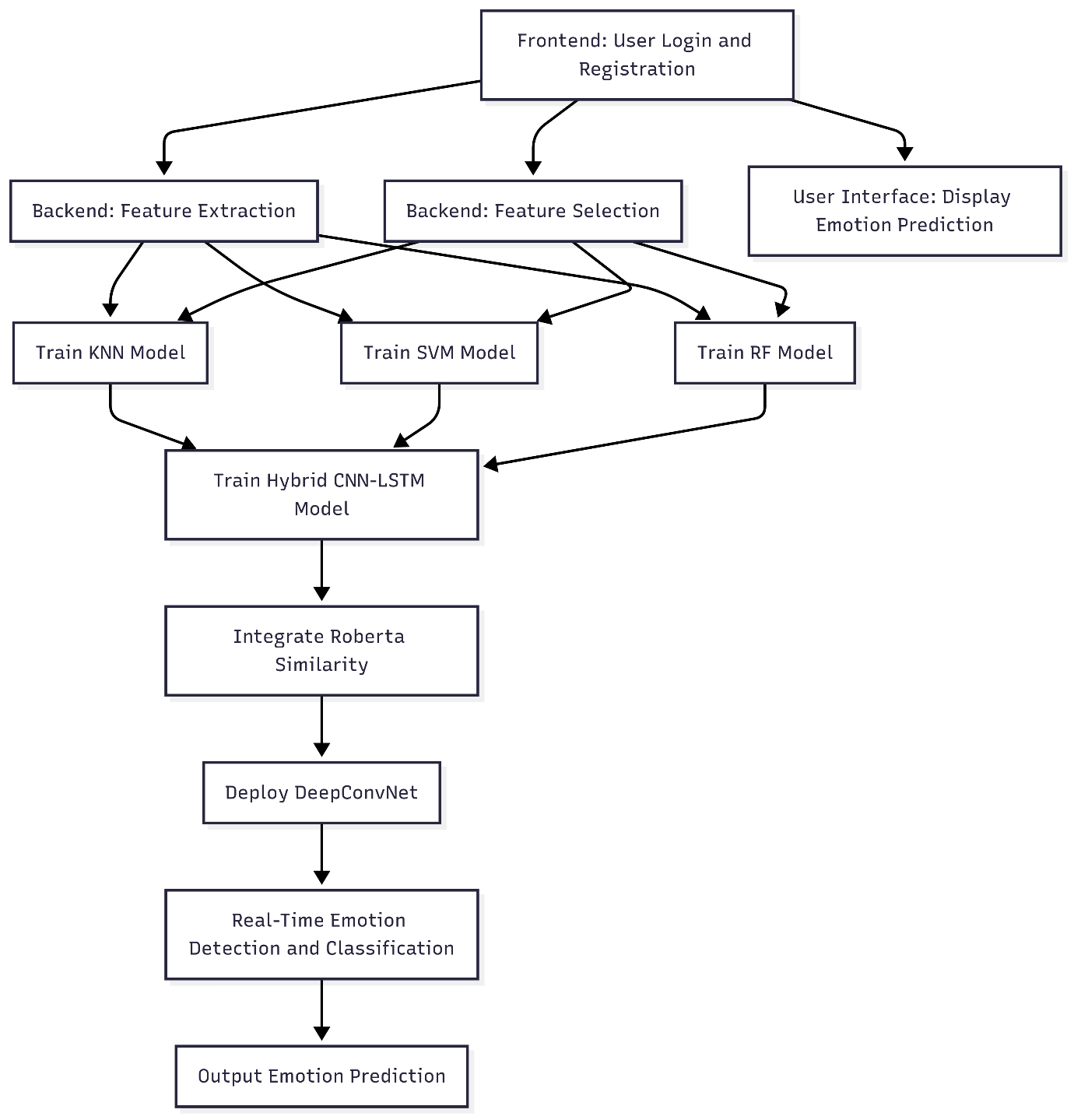
Specifications
SOFTWARE REQUIREMENS
Operating System : Windows 7/8/10
Server side Script : HTML, CSS, Bootstrap & JS
Programming Language : Python
Libraries Flask, Pandas, Torch, Sklearn, Librosa, Numpy , Seaborn, Matplotlib
IDE/Workbench : VSCode
Server Deployment : Xampp Server
Database : MySQL
HARDWARE REQUIREMENTS
Processor - I3/Intel Processor
RAM - 8GB (min)
Hard Disk - 128 GB
Key Board - Standard Windows Keyboard
Mouse - Two or Three Button Mouse
Monitor - Any

Demo Video


Request for Video
 Paper Publishing
Request Call Back
Would you like to receive a free callback now?
Choose the best time for callback:
Leave your message and we will contact you as soon as possible

6-2-85/B, Old Maternity Hospital Road, Thyagaraja Nagar, Tirupati, Andhra Pradesh – 517501
+91 9030333433
+91 9393939065
0877-2261612

Disclaimer - Takeoff Edu Group Projects are not associated or affiliated with IEEE in any way. The IEEE Projects mentioned here are mentioned in the context of student projects, whose ideas are derived from IEEE publications, not projects of or by IEEE.

