EduPredict A Multi?Model Deep Learning and Ensemble Framework for Student Dropout Prediction with Web Deployment
Objective
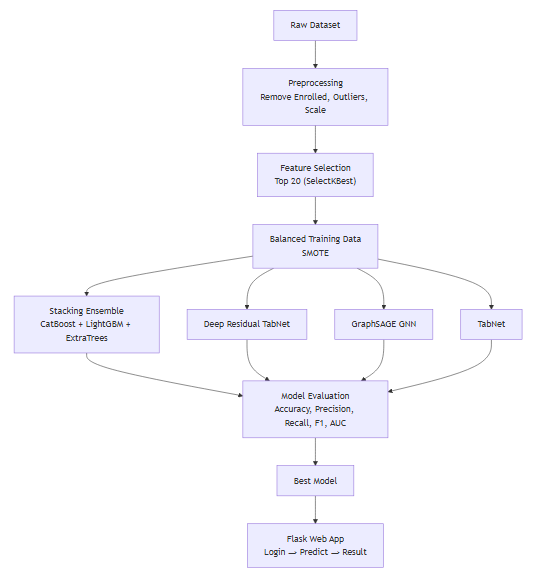
The primary objective is to develop a predictive system that classifies students into Dropout (1) or Graduate (0) using 20 selected academic and demographic features. Four advanced algorithms are implemented and compared: Stacking Ensemble (CatBoost + LightGBM + ExtraTrees with Logistic Regression meta?learner), Deep Residual Tabular Network (DRTN) with residual blocks and attention, GraphSAGE (graph neural network on k?NN student similarity graph), and TabNet (sequential attention for tabular data). Preprocessing includes outlier removal, standardisation, SMOTE balancing, and ANOVA F?test feature selection. The final goal is to deploy the best?performing model (TabNet) via a Flask web application with user authentication and real?time prediction.
Abstract
Student dropout is a significant concern in higher education, impacting institutional effectiveness and learner outcomes. This research develops a predictive system that identifies students at risk of dropout using machine learning and deep learning techniques. The dataset comprises 4,424 student records with 35 demographic, academic, and economic attributes. After preprocessing steps including outlier removal, feature scaling, and class balancing via SMOTE, the top 20 features are selected using ANOVA F-test. Four advanced models are implemented and evaluated: a stacking ensemble combining CatBoost, LightGBM, and ExtraTrees; a Deep Residual Tabular Network (DRTN); a Graph Neural Network (GraphSAGE); and TabNet. The stacking ensemble achieves 90.75% accuracy, TabNet achieves 90.92%, GraphSAGE achieves 90.58%, and DRTN achieves 88.53% accuracy on the test set. A Flask-based web application is built to provide user registration, login, and dropout prediction functionality. The system enables educators to input student data and receive risk classification with probability estimates, facilitating early intervention. The results demonstrate that ensemble methods and attention-based deep learning models are effective for this binary classification task.
Keywords: Student dropout prediction, ensemble learning, Graph Neural Network, TabNet, deep residual network, feature selection, SMOTE, educational data mining, classification, Flask web application.
NOTE: Without the concern of our team, please don't submit to the college. This Abstract varies based on student requirements.
Block Diagram
Specifications
Hardware Requirements
The following hardware specifications are recommended for developing, training, and running the student dropout prediction system. Training deep learning models (DRTN, GraphSAGE, TabNet) benefits from a GPU, but CPU‑only execution is sufficient for inference and for training simpler models like stacking ensemble and LightGBM.
Component
Minimum Requirement
Recommended Requirement
Processor
Intel Core i3 (10th gen or newer) or AMD equivalent
Intel Core i7 / i9 (12th gen+) or AMD Ryzen 7/9
RAM
8 GB
16 GB or higher
Hard Disk
160 GB (SSD preferred)
512 GB NVMe SSD
GPU (Optional)
None (CPU only)
NVIDIA GPU with 6 GB VRAM (e.g., GTX 1060, RTX 2060, RTX 3060, Tesla P100)
Keyboard
Standard keyboard
Standard USB/wireless keyboard
Mouse
Two or three button mouse
Optical mouse
Monitor
SVGA (1024×768)
Full HD (1920×1080) or higher
Software Requirements
The software requirements specification for the student dropout prediction project (using stacking ensemble, DRTN, GraphSAGE, TabNet with a Flask web interface) is presented below.
Category
Requirement
Operating System
Windows 10/11, Linux (Ubuntu 20.04+), or macOS (11+)
Front‑end Languages
HTML5, CSS3, JavaScript
Back‑end Language
Python 3.8 or higher
Web Framework
Flask 2.0+
Deep Learning Framework
PyTorch 1.10+ (with CUDA support optional)
Gradient Boosting Libraries
LightGBM, CatBoost, XGBoost
Ensemble & Other ML
scikit‑learn 1.2+, imbalanced‑learn (SMOTE)
Data Handling
pandas, numpy, scipy
Visualisation
matplotlib, seaborn, SHAP
Hyperparameter Optimisation
Optuna
Model Serialisation
joblib, pickle, torch.save
Development Environment
VS Code, Jupyter Notebook, Kaggle Notebook
Database
Not required (user credentials stored in memory dictionary or simple JSON file; sessions managed by Flask)
Version Control
Git (optional)
Browser Compatibility
Google Chrome, Mozilla Firefox, Microsoft Edge (latest versions)


 Paper Publishing

Request Call Back
Would you like to receive a free callback now?
Choose the best time for callback:
Leave your message and we will contact you as soon as possible

6-2-85/B, Old Maternity Hospital Road, Thyagaraja Nagar, Tirupati, Andhra Pradesh – 517501
+91 9030333433
+91 9393939065
0877-2261612

Disclaimer - Takeoff Edu Group Projects are not associated or affiliated with IEEE in any way. The IEEE Projects mentioned here are mentioned in the context of student projects, whose ideas are derived from IEEE publications, not projects of or by IEEE.

