Early Breast Cancer Prediction Using Thermal Images and Hybrid Feature Extraction-Based System
Objective
The primary objective of this project is to develop an intelligent, non-invasive, and cost-effective system for early prediction of breast cancer using thermal infrared images. By leveraging the unique physiological patterns captured through thermal imaging, the system aims to identify early signs of malignancy without exposing patients to harmful radiation. The project focuses on implementing a hybrid feature extraction approach that combines handcrafted and deep learning features to enhance diagnostic precision. Machine learning classifiers are employed to analyze these features and accurately differentiate between normal and abnormal thermal patterns, ultimately assisting clinicians in early diagnosis and improving patient outcomes.
Abstract
Breast cancer remains one of the most prevalent and life-threatening diseases affecting women worldwide. Early detection plays a vital role in improving survival rates and reducing treatment complications. This study presents a hybrid feature extraction-based system for early prediction of breast cancer using thermal infrared imaging. Thermal imaging offers a non-invasive, cost-effective, and radiation-free alternative for regular screening across all age groups. The proposed approach leverages both spatial and local intensity variations in breast thermal images to capture discriminative patterns associated with abnormal physiological changes. A combination of handcrafted and deep learning-based feature extraction techniques is employed to enhance diagnostic accuracy. The extracted features are then fed into machine learning classifiers to predict potential malignancies. Experimental results demonstrate the effectiveness of the hybrid system in identifying early-stage breast cancer, highlighting its potential as a supplementary tool in clinical decision support systems.
Keywords: Breast Cancer, Thermal Imaging, Early Detection, Hybrid Feature Extraction, Infrared Thermography, Machine Learning, Non-Invasive Screening, Deep Learning, Image Classification, Computer-Aided Diagnosis.
NOTE: Without the concern of our team, please don't submit to the college. This Abstract varies based on student requirements.
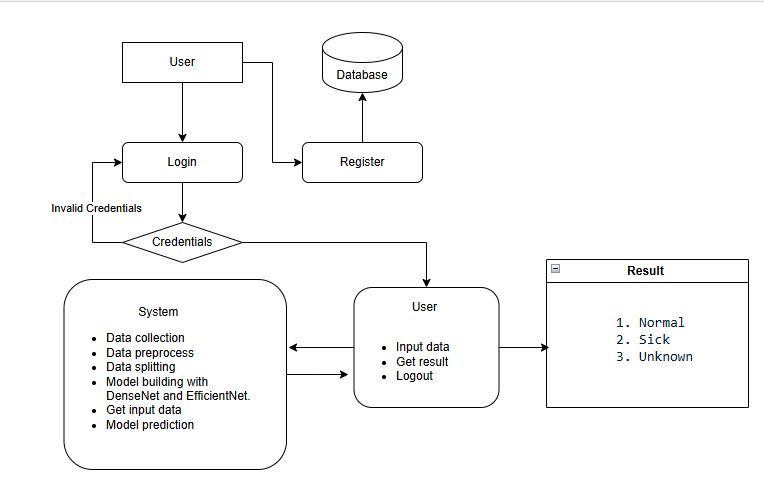
Block Diagram
Specifications
Hardware Requirements
Processor - I3/Intel Processor
Hard Disk - 160GB
Key Board - Standard Windows Keyboard
Mouse - Two or Three Button Mouse
Monitor - SVGA
RAM - 8GB
Software Requirements:
Operating System : Windows 7/8/10
Server side Script : HTML, CSS, Bootstrap & JS
Programming Language : Python
Libraries : Django, Pandas, Os, Numpy, Tensorflow, keras.
IDE/Workbench : VS Code
Technology : Python 3.10
Database : SQLite

Demo Video


Request for Video
 Paper Publishing
Request Call Back
Would you like to receive a free callback now?
Choose the best time for callback:
Leave your message and we will contact you as soon as possible

6-2-85/B, Old Maternity Hospital Road, Thyagaraja Nagar, Tirupati, Andhra Pradesh – 517501
+91 9030333433
+91 9393939065
0877-2261612

Disclaimer - Takeoff Edu Group Projects are not associated or affiliated with IEEE in any way. The IEEE Projects mentioned here are mentioned in the context of student projects, whose ideas are derived from IEEE publications, not projects of or by IEEE.

