E-LEARNING-BASED CLOUD COMPUTING ENVIRONMENT
Objective
The objective of this project is to conduct a systematic review on the integration of e-learning within cloud computing environments. It aims to analyze the impact, synergies, challenges, and opportunities of this integration, focusing on two core research questions: 1) How does e-learning influence architectural design and virtual environments within cloud computing? 2) What are the implementation strategies and optimizations needed for effective e-learning across various educational settings? The study identifies key trends and emphasizes architectural considerations, software implementations, and performance optimizations to provide actionable insights for administrators and students. The goal is to enhance understanding of the evolving landscape of e-learning in cloud computing, benefiting educational stakeholders.
Abstract
New technologies are reshaping education by shifting traditional offline learning to dynamic online formats. This systematic review explores the integration of e-learning within a cloud computing environment, focusing on its impact, synergies, challenges, and opportunities. The study addresses two core research questions: the influence of e-learning on architectural design, and virtual environments; and an examination of e-learning integration across different educational settings. This research identifies key trends and areas of focus, emphasizing architectural considerations, software implementations, and performance optimizations in e-learning environments. Comprehensive understanding of how e-learning is evolving within cloud computing frameworks, providing actionable insights for administrators and students alike.
KEYWORDS: Admin, students, Cloud-computing, Courses, Assessments, Rating.
NOTE: Without the concern of our team, please don't submit to the college. This Abstract varies based on student requirements.
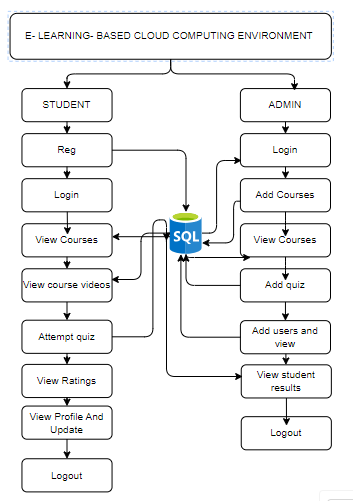
Block Diagram
Specifications
H/W CONFIGURATION:
Processor - I3/Intel Processor
Hard Disk - 160GB
Key Board - Standard Windows Keyboard
Mouse - Two or Three Button Mouse
Monitor - SVGA
RAM - 8GB
S/W CONFIGURATION:
• Operating System : Windows 7/8/10
• Server side Script : HTML, CSS, Bootstrap & JS
• Programming Language : Python
• Libraries : Flask or Django, Pandas, Mysql.connector, Os, Smtplib, Numpy
• IDE/Workbench : PyCharm
• Technology : Python 3.6+
• Server Deployment : Xampp Server


 Paper Publishing

Request Call Back
Would you like to receive a free callback now?
Choose the best time for callback:
Leave your message and we will contact you as soon as possible

6-2-85/B, Old Maternity Hospital Road, Thyagaraja Nagar, Tirupati, Andhra Pradesh – 517501
+91 9030333433
+91 9393939065
0877-2261612

Disclaimer - Takeoff Edu Group Projects are not associated or affiliated with IEEE in any way. The IEEE Projects mentioned here are mentioned in the context of student projects, whose ideas are derived from IEEE publications, not projects of or by IEEE.

