Dynamic Service in Placement in Edge Computing using nature-Inspired Optimazation Algorithms
Objective
To conduct a comprehensive comparative analysis of nature-inspired optimization algorithms for dynamic service placement in edge computing, aiming to improve application QoS and resource utilization. The study seeks to evaluate the performance of different algorithms across diverse scenarios, identifying their strengths and weaknesses to guide the selection of effective optimization techniques for adaptive service deployment.
Abstract
Edge computing has emerged as a promising solution for delivering services that demand low latency, high bandwidth, and stringent privacy requirements in numerous data- and compute-intensive applications, such as those in Smart Cities. Heterogeneity in edge computing resources and diverse application requirements demand adaptive optimization techniques, such as service placement, to conform to changing conditions. A service placement model must optimize the selection of edge nodes for deploying and executing services, thereby improving application QoS and maximizing resource utilization. Numerous optimization techniques for adaptive service placement problem have been proposed in the recent past. However, in most cases, the results have been evaluated in limited scenarios. This paper presents a comprehensive comparative study evaluating representative optimization algorithms applied to the problem of dynamic service placement across various application scenarios. The study covers nature-inspired approaches, including both meta-heuristics and reinforcement learning. Our experimental findings offer valuable insights into the strengths and weaknesses of the selected nature-inspired algorithms for service placement optimization, evaluated for applications with different QoS requirements. In our analysis, the Genetic Algorithm shows superior performance in achieving lower average distance and the average number of servers selected. Particle Swarm Optimization excels in minimizing average waiting time and placement decision time. The Artificial Bee Colony maintains low average latency, whereas the RL Proximal Policy Optimization demonstrates superior performance in terms of balancing the utilization of network resources.
Keywords: Edge computing, dynamic service placement, multi-objective optimization, meta heuristics, nature-inspired algorithms, service offloading, computational offloading, service scheduling.
NOTE: Without the concern of our team, please don't submit to the college. This Abstract varies based on student requirements.
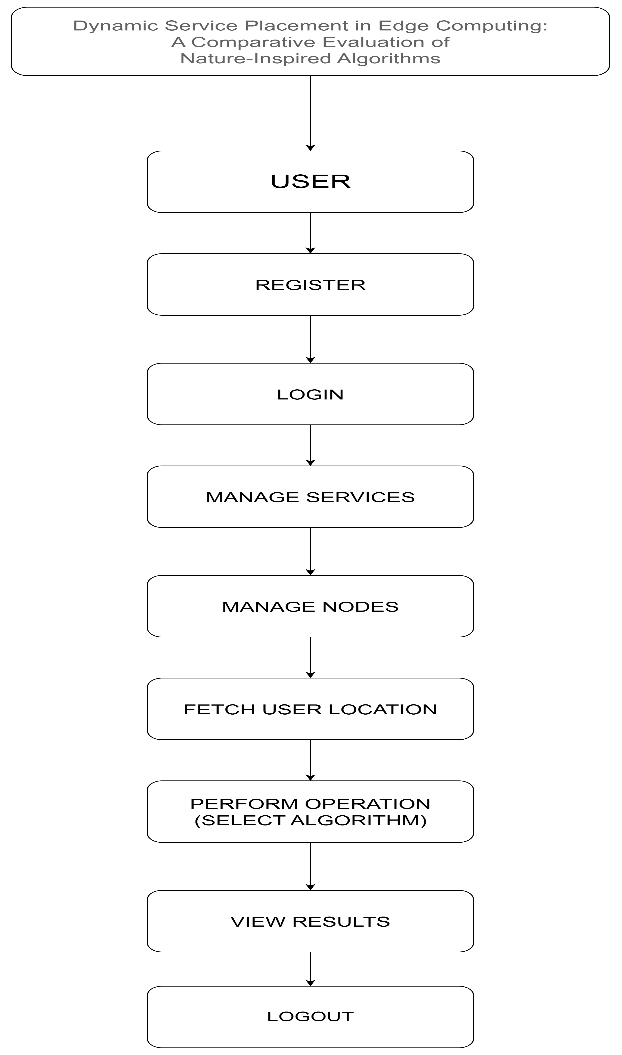
Block Diagram
Specifications
SOFTWARE REQUIREMENTS:
· Operating System : Windows10/11 or macOS
· Application Server : Tomcat 7.0
· Front End : HTMLCSS, React JS
· Scripts : JavaScript.
· Backend Language : Java with Spring Boot
· Database : MySQL
· IDE : IntelliJ IDEA or Eclipse
HARDWARE REQUIREMENTS:
· Processor : Intel i3 or equivalent
· RAM : 4GB
· Hard Disk : 500 GB


Related Projects
 Paper Publishing

Request Call Back
Would you like to receive a free callback now?
Choose the best time for callback:
Leave your message and we will contact you as soon as possible

6-2-85/B, Old Maternity Hospital Road, Thyagaraja Nagar, Tirupati, Andhra Pradesh – 517501
+91 9030333433
+91 9393939065
0877-2261612

Disclaimer - Takeoff Edu Group Projects are not associated or affiliated with IEEE in any way. The IEEE Projects mentioned here are mentioned in the context of student projects, whose ideas are derived from IEEE publications, not projects of or by IEEE.

