Dual-Perception Detector for Ship Detection in SAR Images
Objective
The primary objective of this project is to design and implement a dual-perception ship detection system for synthetic aperture radar (SAR) imagery that integrates three complementary models—OBB?SAR?HyperNet, Rotated?Ship?PrecisionNet, and YOLOv8—to simultaneously achieve high orientation sensitivity, precise rotation?aware regression, and real?time detection speed. This system aims to overcome challenges such as speckle noise, cluttered backgrounds, and varying ship orientations, while effectively handling small, overlapping, and occluded ships. Performance will be rigorously evaluated using precision, recall, F1?score, mean average precision (mAP), and inference speed, with the goal of outperforming conventional object detectors. Ultimately, the project seeks to deliver a scalable and adaptable framework that enhances maritime surveillance, port management, navigation safety, and coastal security through automated, high?accuracy ship identification in SAR images.
Abstract
Ship detection in synthetic aperture radar (SAR) images is a critical task for maritime surveillance, port management, navigation safety, and coastal security. SAR images often contain speckle noise, cluttered backgrounds, and varying ship orientations, which make automated detection challenging. This project introduces a dual-perception detector that combines rotation-aware detection networks and YOLO-based real-time detection to improve the accuracy and efficiency of ship identification in SAR imagery. The system utilizes three models: OBB-SAR-HyperNet, Rotated-Ship-PrecisionNet, and YOLOv8. OBB-SAR-HyperNet focuses on orientation-sensitive detection, accurately capturing rotated ships and refining bounding boxes. Rotated-Ship-PrecisionNet enhances precision through rotation-aware regression, while YOLOv8 provides fast, real-time detection with robust feature extraction. The combination of these models allows the system to handle small, overlapping, and occluded ships effectively. Performance is evaluated using metrics such as precision, recall, F1-score, mean average precision (mAP), and inference speed. Comparative analysis demonstrates that the dual-perception approach outperforms conventional object detectors in both accuracy and reliability. This framework is scalable and adaptable, offering practical utility for automated maritime monitoring and security applications. The project highlights the benefits of integrating orientation-aware deep learning models with high-speed detectors to address complex detection challenges in SAR imagery.
Keywords: SAR Images, Ship Detection, Deep Learning, Rotation-Aware Detection, OBB-SAR-HyperNet, Rotated-Ship-PrecisionNet, YOLOv8, Object Detection, Maritime Surveillance, mAP.
NOTE: Without the concern of our team, please don't submit to the college. This Abstract varies based on student requirements.
Block Diagram
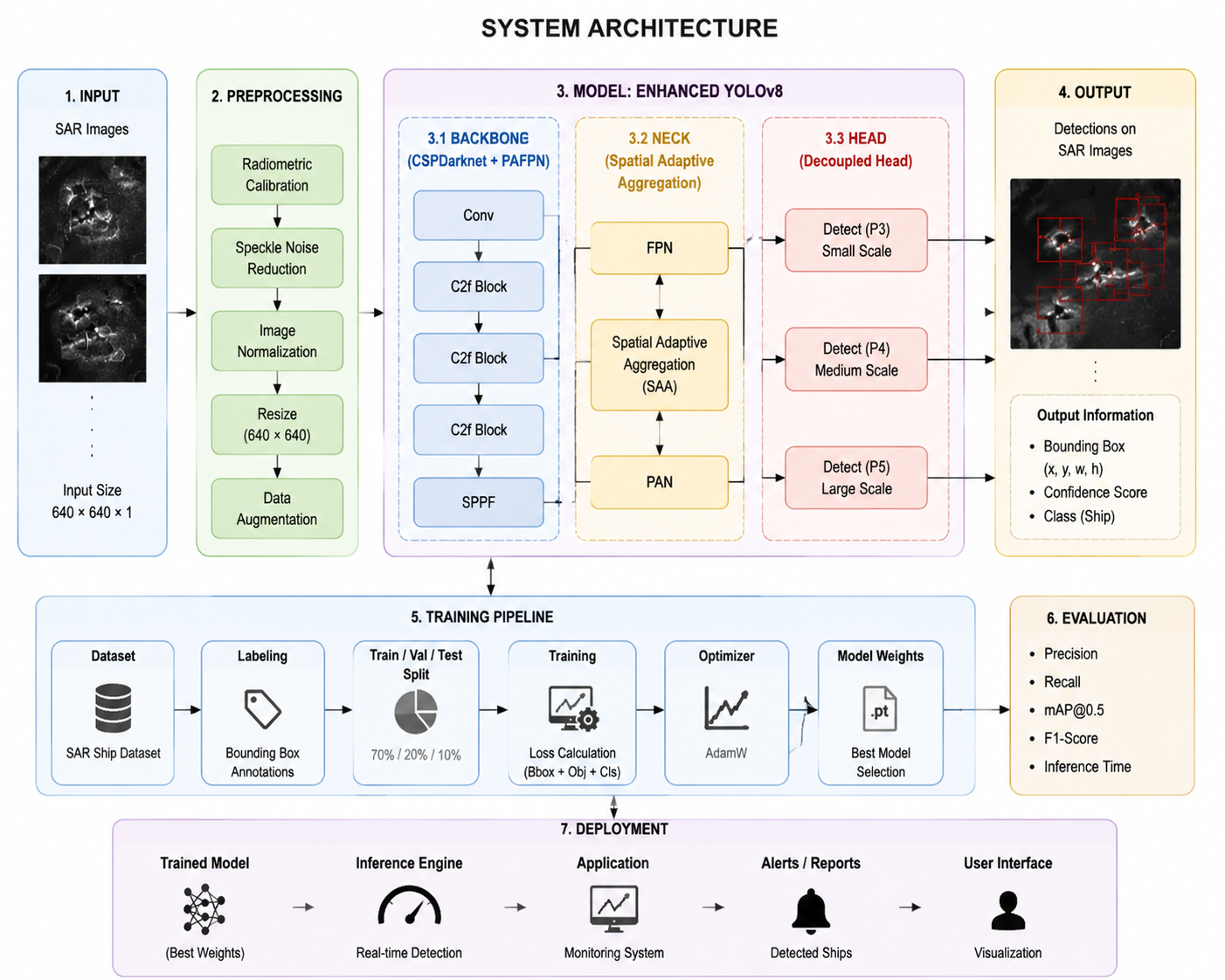
Specifications
4.1 SOFTWARE REQUIREMENS
Operating System : Windows 7/8/10
Server side Script : HTML, CSS & JS
Programming Language : Python
Libraries : PyTorch — Ultralytics YOLOv8 — OpenCV — NumPy — Pandas — Matplotlib.
IDE/Workbench : VSCode
Server Deployment : MYSQL
Database : MySQL
4.2 HARDWARE REQUIREMENTS
Processor - I3/Intel Processor
RAM - 8GB (min)
Hard Disk - 128 GB
Key Board - Standard Windows Keyboard
Mouse - Two or Three Button Mouse
Monitor - Any


 Paper Publishing

Request Call Back
Would you like to receive a free callback now?
Choose the best time for callback:
Leave your message and we will contact you as soon as possible

6-2-85/B, Old Maternity Hospital Road, Thyagaraja Nagar, Tirupati, Andhra Pradesh – 517501
+91 9030333433
+91 9393939065
0877-2261612

Disclaimer - Takeoff Edu Group Projects are not associated or affiliated with IEEE in any way. The IEEE Projects mentioned here are mentioned in the context of student projects, whose ideas are derived from IEEE publications, not projects of or by IEEE.

