Dual Axis Solar Tracking System
Abstract
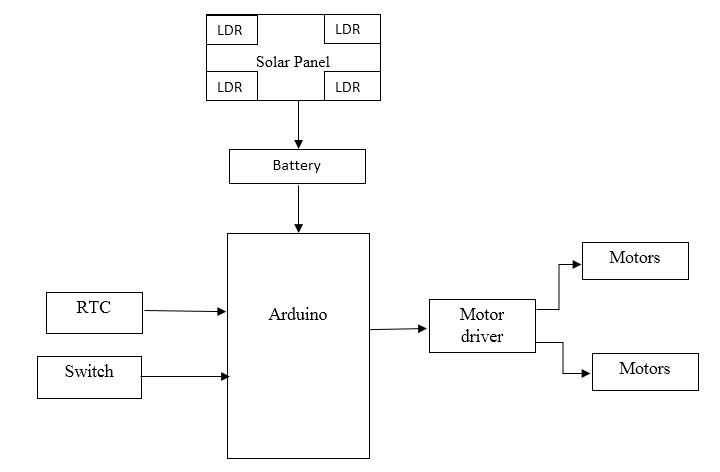
The main goal of this project is to design a very precise solar tracker. The project is divided into two parts; hardware and software. Hardware part generally composed of solar panel, two-DC motors with gearbox, LDR sensor module and electronic circuit. Software part represents the thinking behavior of the system, that is how the system acting under several weather conditions. In this work sensing of the sun position carried out in two stages primary and secondary. Primary stage or indirect sensing performed via sun-earth relationship as a coarse adjustment and second stage or direct sensing performed via set of LDR sensors as output tuning to trims the azimuth and altitude angles. If the weather is cloudy or dusty, the tracking system uses primary stage or sun-earth geometrical relationships only to identify the location of the sun; so the system tracks the position of the sun regardless the weather condition. The energy extracted from photovoltaic (PV) or any solar collector depends on solar irradiance. For maximum extraction of energy from the sun, the solar collector panel should always be normal to the incident radiation Solar trackers moves the solar collector to follow the sun path and keeps the orientation of the solar collector at an optimal tilt angle. Solar tracking system improves substantially the energy efficiency of photovoltaic (PV) panel. In this paper, an automatic dual axis solar tracking system is designed and developed using Light Dependent Resistor (LDR) and DC motors on a mechanical structure with gear arrangement. Two axis solar tracking (azimuth angle as well as altitude angle) is implemented through Arduino UNO controller based on Sun Earth Geometry, We are using RTC module for indirect sensing performed to move solar panel base real time clock with the control of arduino. We change two modes with help of a switch.The results indicated that the automatic solar tracking system is more reliable and efficient than fixed one.
NOTE: Without the concern of our team, please don't submit to the college. This Abstract varies based on student requirements.
Block Diagram
Specifications
Learning Outcomes
- Arduino pin diagram and architecture
- How to install Arduino IDE software
- Setting up and installation procedure for Arduino
- Introduction to Arduino IDE
- Basic coding in Arduino IDE
- Working of Motor driver and DC motor
- Interface Motor driver and DC motor with Arduino?
- Working of LDR
- Interface LDR with Arduino?
- Working of power supply
- About Project Development Life Cycle:
- Planning and Requirement Gathering (software’s, Tools, Hardware components, etc.,)
- Schematic preparation
- Code development and debugging
- Hardware development and debugging
- Development of the Project and Output testing
- Practical exposure to:
- Hardware and software tools.
- Solution providing for real time problems.
- Working with team/ individual.
- Work on Creative ideas.
- Project development Skills
- Problem analyzing skills
- Problem solving skills
- Creativity and imaginary skills
- Programming skills
- Deployment
- Testing skills
- Debugging skills
- Project presentation skills
- Thesis writing skills
Demo Video


Request for Video
 Paper Publishing
Request Call Back
Would you like to receive a free callback now?
Choose the best time for callback:
Leave your message and we will contact you as soon as possible

6-2-85/B, Old Maternity Hospital Road, Thyagaraja Nagar, Tirupati, Andhra Pradesh – 517501
+91 9030333433
+91 9393939065
0877-2261612

Disclaimer - Takeoff Edu Group Projects are not associated or affiliated with IEEE in any way. The IEEE Projects mentioned here are mentioned in the context of student projects, whose ideas are derived from IEEE publications, not projects of or by IEEE.

