Driver And Passenger Identification From Smartphone Data
Also Available Domains Embedded applications
Abstract
The objective of this paper is twofold. First, it presents a brief overview of existing driver and passenger identification or recognition approaches, which rely on smartphone data. This includes listing the typically available sensory measurements and highlighting a few key practical considerations for automotive settings. Second, a simple identification method that utilizes the smartphone inertial measurements and, possibly, doors signal is proposed. It is based on analyzing the user behavior during entry, namely, the direction of turning, and extracting relevant salient features, which are distinctive depending on the side of entry to the vehicle. This is followed by applying a suitable classifier and decision criterion. Experimental data is shown to demonstrate the usefulness and effectiveness of the introduced probabilistic, low-complexity, identification technique.Abstract The objective of this paper is twofold. First, it presents a brief overview of existing driver and passenger identification or recognition approaches, which rely on smartphone data. This includes listing the typically available sensory measurements and highlighting a few key practical considerations for automotive settings. Second, a simple identification method that utilizes the smartphone inertial measurements and, possibly, doors signal is proposed. It is based on analyzing the user behavior during entry, namely, the direction of turning, and extracting relevant salient features, which are distinctive depending on the side of entry to the vehicle. This is followed by applying a suitable classifier and decision criterion. Experimental data is shown to demonstrate the usefulness and effectiveness of the introduced probabilistic, low-complexity, identification technique.
NOTE: Without the concern of our team, please don't submit to the college. This Abstract varies based on student requirements.
Block Diagram
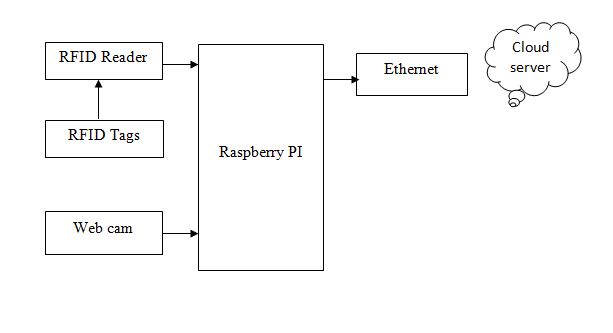
Specifications
Learning Outcomes
- Raspberry pi pin diagram and architecture
- How to install Raspberry pi IDE software
- Setting up and installation procedure for Raspbian
- Basic coding in Raspbian
- Basic of python language
- Working of RFID Reader
- How to interface RFID Reader with Raspberry pi?
- Working of Web camera
- About Project Development Life Cycle:
- Planning and Requirement Gathering (software’s, Tools, Hardware components, etc.,)
- Schematic preparation
- Code development and debugging
- Hardware development and debugging
- Development of the Project and Output testing
- Practical exposure to:
- Hardware and software tools.
- Solution providing for real time problems.
- Working with team/ individual.
- Work on Creative ideas.
- Project development Skills
- Problem analyzing skills
- Problem solving skills
- Creativity and imaginary skills
- Programming skills
- Deployment
- Testing skills
- Debugging skills
- Project presentation skills
- Thesis writing skills


 Paper Publishing

Request Call Back
Would you like to receive a free callback now?
Choose the best time for callback:
Leave your message and we will contact you as soon as possible

6-2-85/B, Old Maternity Hospital Road, Thyagaraja Nagar, Tirupati, Andhra Pradesh – 517501
+91 9030333433
+91 9393939065
0877-2261612

Disclaimer - Takeoff Edu Group Projects are not associated or affiliated with IEEE in any way. The IEEE Projects mentioned here are mentioned in the context of student projects, whose ideas are derived from IEEE publications, not projects of or by IEEE.

