Drift-aware Methodology For Anomaly Detection In Smart Grid
Abstract
Drift-Aware Methodology for Anomaly Detection in Smart Grid
Abstract
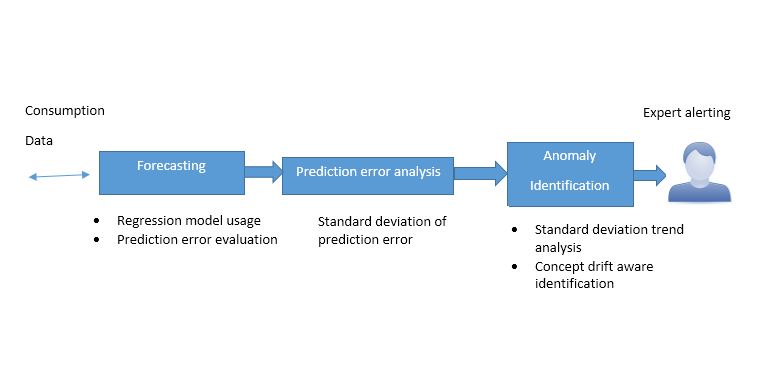
The core of the framework is the anomaly detection process depicted in smart grid. It analyzes the prediction errors achieved by the neural network trained in the previous phase in order to distinguish between normal or anomalous behaviors. Energy efficiency and sustainability are important factors to address in the context of smart cities. In this sense, smart metering and nonintrusive load monitoring play a crucial role in fighting energy thefts and for optimizing the energy consumption of the home, building, city, and so forth. The estimated number of smart meters will exceed 800 million by 2020. By providing near real-time data about power consumption, smart meters can be used to analyze electricity usage trends and to point out anomalies guaranteeing companies' safety and avoiding energy wastes. In literature, there are many proposals approaching the problem of anomaly detection. This research work focuses on the need to define anomaly detection method capable of facing the concept drift, for instance, family structure changes; a house becomes a second residence, and so forth. The proposed methodology adopts long short term memory network in order to profile and forecast the consumers' behavior based on their recent past consumptions. The continuous monitoring of the consumption prediction errors allows us to distinguish between possible anomalies and changes in normal behavior that correspond to different error motifs. The experimental results demonstrate the suitability of the proposed framework by pointing out an anomaly in a near real-time after a training period of one week.
NOTE: Without the concern of our team, please don't submit to the college. This Abstract varies based on student requirements.
Block Diagram
Specifications


 Paper Publishing

Request Call Back
Would you like to receive a free callback now?
Choose the best time for callback:
Leave your message and we will contact you as soon as possible

6-2-85/B, Old Maternity Hospital Road, Thyagaraja Nagar, Tirupati, Andhra Pradesh – 517501
+91 9030333433
+91 9393939065
0877-2261612

Disclaimer - Takeoff Edu Group Projects are not associated or affiliated with IEEE in any way. The IEEE Projects mentioned here are mentioned in the context of student projects, whose ideas are derived from IEEE publications, not projects of or by IEEE.

