Distributed Learning Algorithms for Optimal Data Routing in IoT Networks
Objective
The problem we address is to compute a suitable rate-distortion working point for the compression scheme at the source nodes, while jointly assessing the most energy-efficient routing paths for the data they transmit, under channel access, distortion and capacity constraints
Abstract
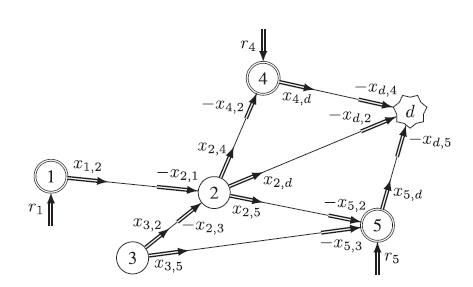
In this project, we consider and work on the problem of joint lossy data compression and data routing in distributed Internet of Things (IoT). Heterogeneous sources compress their data using a source-specific lossy compression scheme, where heterogeneity is meant in terms of signal type and/or transmission rates.
The compressed data is thus disseminated in a multi-hop fashion until it reaches a data collector (the IoT gateway). The problem we address is to compute a suitable rate-distortion working point for the compression scheme at the source nodes, while jointly assessing the most energy efficient routing paths for the data they transmit, under channel access, distortion and capacity constraints.
This is formulated as a multi-objective optimization problem that is solved through distributed learning algorithms, where source coding and routing configurations emerge as the result of local interactions among the network devices. Our final algorithm is based on the alternating direction method of multipliers (ADMM), which is accelerated using the most recent findings from the literature.
As a result, it has faster convergence (up to three times) to the global optimum than standard ADMM. Numerical results are discussed for selected network scenarios, emphasizing the interrelations that exist between signal reconstruction quality at the IoT gateway and total transport energy in the network.
Keywords: Flow allocation, source coding, compression, Internet of Things (IoT), optimization, alternating direction method of multipliers (ADMM).
NOTE: Without the concern of our team, please don't submit to the college. This Abstract varies based on student requirements.
Block Diagram
Specifications
Software & Hardware Requirements:
Software: Matlab 2018a or above
Hardware:
Operating Systems:
- Windows 10
- Windows 7 Service Pack 1
- Windows Server 2019
- Windows Server 2016
Processors:
Minimum: Any Intel or AMD x86-64 processor
Recommended: Any Intel or AMD x86-64 processor with four logical cores and AVX2 instruction set support
Disk:
Minimum: 2.9 GB of HDD space for MATLAB only, 5-8 GB for a typical installation
Recommended: An SSD is recommended a full installation of all Math Works products may take up to 29 GB of disk space
RAM:
Minimum: 4 GB
Recommended: 8 GB
Learning Outcomes
- Introduction to Matlab
- What is EISPACK & LINPACK
- How to start with MATLAB
- About Matlab language
- Matlab coding skills
- About tools & libraries
- Application Program Interface in Matlab
- About Matlab desktop
- How to use Matlab editor to create M-Files
- Features of Matlab
- Basics on Matlab
- Basics of wireless sensor networks
- About IoT modules
- How system modal can be formed in Matlab.
- Construction of algorithm according to system modal
- Analyzing and visualization of plots.
- About routing protocols.
- About data distribution learning algorithms.
- Phases of data transmission:
- Generation of input data
- Construction of WSN nodes
- Clustering in WSN.
- How to extend our work to another real time applications
- Project development Skills
- Problem analyzing skills
- Problem solving skills
- Creativity and imaginary skills
- Programming skills
- Deployment
- Testing skills
- Debugging skills
- Project presentation skills
- Thesis writing skills


 Paper Publishing

Request Call Back
Would you like to receive a free callback now?
Choose the best time for callback:
Leave your message and we will contact you as soon as possible

6-2-85/B, Old Maternity Hospital Road, Thyagaraja Nagar, Tirupati, Andhra Pradesh – 517501
+91 9030333433
+91 9393939065
0877-2261612

Disclaimer - Takeoff Edu Group Projects are not associated or affiliated with IEEE in any way. The IEEE Projects mentioned here are mentioned in the context of student projects, whose ideas are derived from IEEE publications, not projects of or by IEEE.

