Distributed Beams: Concept of Operations for Polarimetric Rotating Phased Array Radar
Objective
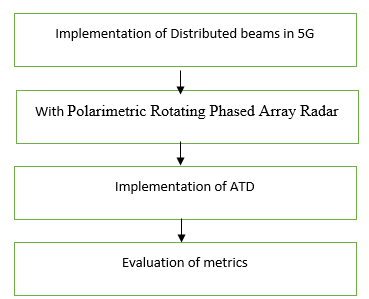
The objective of this study is to Develop a comprehensive concept of operations (CONOPS) for implementing distributed beam techniques in polarimetric rotating phased array radar systems. Enhance target detection, tracking, and classification by leveraging the benefits of polarimetric processing and distributed beamforming. Improve system flexibility and reliability by integrating advanced beam distribution methods into the radar architecture, validated through simulation and field testing.
Abstract
Important requirements for a future generation of weather surveillance radars include improvements in data quality and more rapid update of volumetric data. Phased array radar (PAR) is a candidate technology capable of providing the required functionality. The rotating PAR (RPAR) is a potential architecture that could improve the capabilities of the current parabolic-reflector-based US Weather Surveillance Radar—1988 Doppler (WSR-88D) operational network and is more affordable than other candidate PAR architectures. However, RPAR concept of operations that support observational needs has to be developed. The Distributed Beams (DB) technique introduced in this article provides a way to either reduce the scan times or to reduce the variance of radar-variable estimates by azimuthally spoiling the transmit beam while receiving multiple digital beams as the radar rotates in azimuth. Specifically, the rotation speed of the pedestal is derived from the duration of the coherent processing interval (CPI) to produce the desired spatial sampling. This results in beams from subsequent CPIs in approximately the same directions, which increases the number of available data samples for processing. The increased number of available samples can be coherently processed to reduce the variance of estimates. Alternatively, by reducing the number of samples per CPI and increasing the RPAR’s rotation rate, the scan time can be reduced without increasing the variance of estimates. Results presented demonstrate both applications of the DB technique for dual-polarization observations. Given that this technique makes use of spoiled transmit beams, its benefits come at the expense of degraded angular resolution (beamwidth and sidelobe levels), and reduced sensitivity compared with the use of pencil beams. The technique could be implemented as part of an RPAR concept of operations to meet requirements for the future weather surveillance network if certain tradeoffs are accounted for in the radar design process.
Keywords: Phased Array Radar, Rotating Phased Array Radar, Digital Beamforming, Weather Radar, Dual-Polarization, Concept of Operations.
NOTE: Without the concern of our team, please don't submit to the college. This Abstract varies based on student requirements.
Block Diagram
Specifications
Software Requirements: MATLAB R2022b or above
Hardware Requirements:
Operating Systems:
• Windows 10
• Windows 7 Service Pack 1
• Windows Server 2019
• Windows Server 2016
Processors:
Minimum: Any Intel or AMD x86-64 processor
Recommended: Any Intel or AMD x86-64 processor with four logical cores and AVX2 instruction set support.
Disk:
Minimum: 2.9 GB of HDD space for MATLAB only, 5-8 GB for a typical installation
Recommended: An SSD is recommended a full installation of all MathWorks products may take up to 29 GB of disk space
RAM:
Minimum: 4 GB
Recommended: 8 GB
Learning Outcomes
· Introduction to Matlab
· What is EISPACK & LINPACK
· How to start with MATLAB
· About Matlab language
· Matlab coding skills
· About tools & libraries
· Application Program Interface in Matlab
· About Matlab desktop
· How to use Matlab editor to create M-Files
· Features of Matlab
· Basics on Matlab
· What is Communication?
· About Communication
· Introduction to Communication
· How Communication Works?
· Importing the System Design, Characterization and Visualization
· Analyzing of BER tool
· Analyzing of Error Rate Test Console
· Generation of WSN
· WSN network creation
· Nodes Communication
· Clustering
· Routing
· Convolutional
· Equalization and Synchronization etc.,
· How to extend our work to another real time applications
· Project development Skills
o Problem analyzing skills
o Problem solving skills
o Creativity and imaginary skills
o Programming skills
o Deployment
o Testing skills
o Debugging skills
o Project presentation skills
o Thesis writing skills
Demo Video


Request for Video
 Paper Publishing
Request Call Back
Would you like to receive a free callback now?
Choose the best time for callback:
Leave your message and we will contact you as soon as possible

6-2-85/B, Old Maternity Hospital Road, Thyagaraja Nagar, Tirupati, Andhra Pradesh – 517501
+91 9030333433
+91 9393939065
0877-2261612

Disclaimer - Takeoff Edu Group Projects are not associated or affiliated with IEEE in any way. The IEEE Projects mentioned here are mentioned in the context of student projects, whose ideas are derived from IEEE publications, not projects of or by IEEE.

