Disease Detection Using Heart Sound Classification
Objective
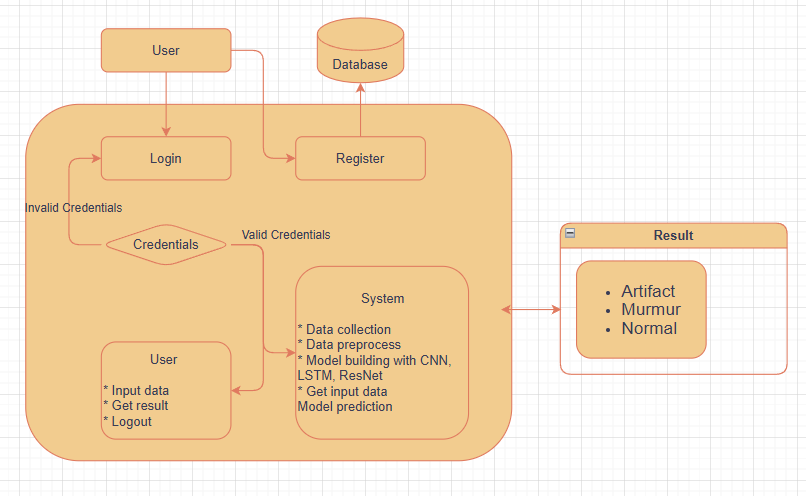
The problem addressed by this project is the difficulty in accurately and efficiently diagnosing cardiovascular diseases based on heart sounds. Heart murmurs, artifacts, and normal heartbeats can be challenging to distinguish, especially for non-expert healthcare providers. Manual interpretation of heart sounds is time-consuming and prone to human error, leading to delayed diagnoses and potentially incorrect treatment. This project aims to develop an automated system using advanced machine learning algorithms, such as CNN, LSTM, and ResNet, to classify heart sounds into categories (artifact, murmur, and normal), providing a faster, more reliable, and scalable solution for early disease detection.
Abstract
NOTE: Without the concern of our team, please don't submit to the college. This Abstract varies based on student requirements.
Block Diagram
Specifications
SOFTWARE FRONT END REQUIREMENTS
H/W CONFIGURATION:
· Processor : I5/Intel Processor
· RAM : 8GB (min)
· Hard Disk : 128 GB
S/W CONFIGURATION:
• Operating System : Windows 10
• Server-side Script : Python 3.6
• IDE : PyCharm, Jupyter notebook
• Libraries Used : Numpy, IO, OS, Flask, Keras, pandas, tensorflow

Demo Video


Request for Video
 Paper Publishing
Request Call Back
Would you like to receive a free callback now?
Choose the best time for callback:
Leave your message and we will contact you as soon as possible

6-2-85/B, Old Maternity Hospital Road, Thyagaraja Nagar, Tirupati, Andhra Pradesh – 517501
+91 9030333433
+91 9393939065
0877-2261612

Disclaimer - Takeoff Edu Group Projects are not associated or affiliated with IEEE in any way. The IEEE Projects mentioned here are mentioned in the context of student projects, whose ideas are derived from IEEE publications, not projects of or by IEEE.

