Disaster Detection on the Fly: Optimized Transformers for UAV
Objective
The objective of this project is to develop an optimized deep learning solution for the classification of disaster-related scenarios using UAVs (Unmanned Aerial Vehicles). Specifically, the project focuses on classifying five key categories: collapsed buildings, fire, flooded areas, traffic incidents, and normal conditions. By leveraging the EfficientViT and DaViT (Dual Attention Vision Transformer) models, the primary goal is to achieve high accuracy in classifying disaster scenarios from aerial images. This system aims to provide faster decision-making capabilities, enabling timely response to natural and man-made disasters, ultimately reducing damage and enhancing disaster management efforts.
Abstract
This project aims to develop an optimized solution for the classification of disaster-related scenarios using advanced deep learning techniques. The dataset comprises multiple disaster categories, including collapsed buildings, fire, flooded areas, traffic incidents, and normal conditions. The classification task is tackled using two transformer-based models, EfficientViT and DaViT, which are known for their high accuracy and efficiency in handling complex image classification tasks. The EfficientViT_B1 model achieves an accuracy of 98.03%, while the DaViT_Tiny model shows a slight improvement with an accuracy of 98.14%. The models are evaluated based on metrics such as accuracy, precision, recall, and F1-score to ensure robust performance. This system, aimed at UAVs, assists in classifying disaster scenarios from aerial imagery, enabling faster response times and effective disaster management strategies. The user interface is built as a web application, offering an easy-to-use platform for UAV operators to quickly assess disaster areas from real-time images.
Keywords: Disaster Detection, UAV, Image Classification, EfficientViT, DaViT, Deep Learning, Transformer Models, Disaster Management, Aerial Imagery, Classification Accuracy.
NOTE: Without the concern of our team, please don't submit to the college. This Abstract varies based on student requirements.
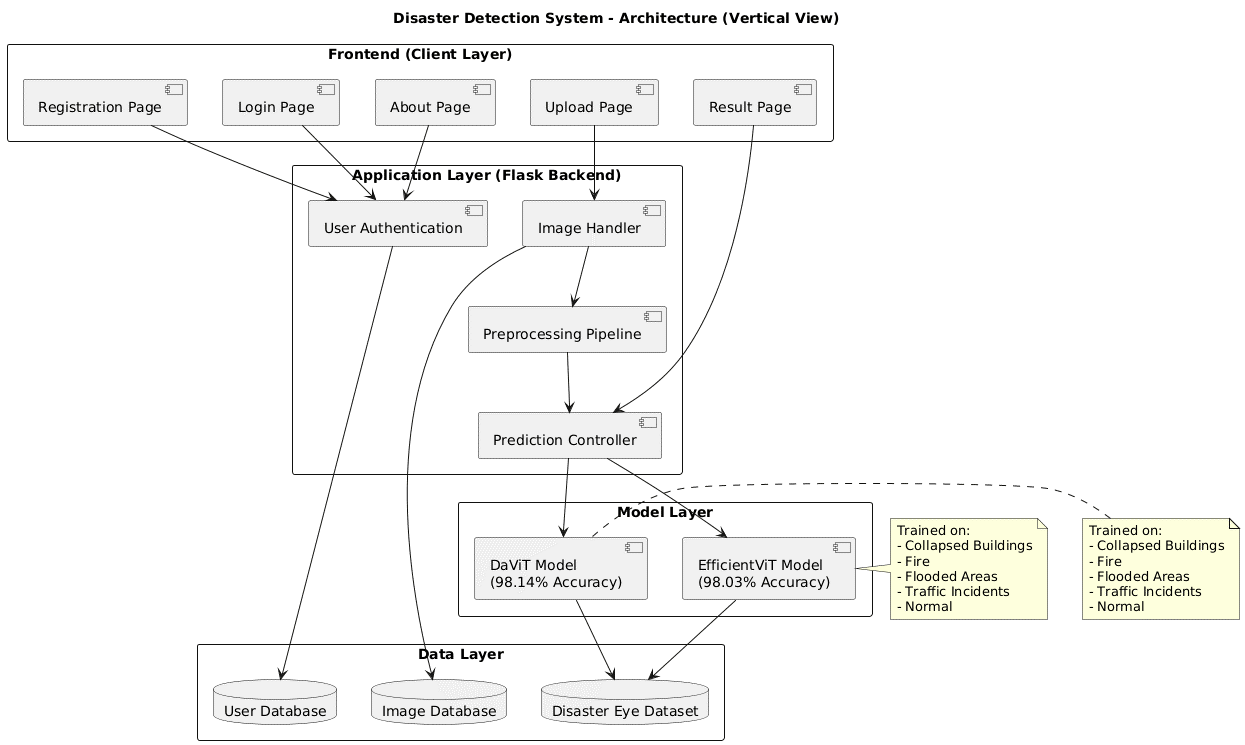
Block Diagram
Specifications
SOFTWARE REQUIREMENS
Operating System : Windows 7/8/10
Server-side Script : Streamlit
Programming Language : Python
Libraries : Flask, Pandas, Sklearn,Tensorflow NumPy, Seaborn, Matplotlib
IDE/Workbench : VSCode
Technology : Python 3.8+
Server Deployment : Xampp Server
Database : MySQL .
HARDWARE REQUIREMENTS
Processor - I5/Intel Processor
RAM - 8GB +(min)
Hard Disk - 128 +GB
Key Board - Standard Windows Keyboard
Mouse - Two or Three Button Mouse
Monitor - Any

Demo Video


Request for Video
 Paper Publishing
Request Call Back
Would you like to receive a free callback now?
Choose the best time for callback:
Leave your message and we will contact you as soon as possible

6-2-85/B, Old Maternity Hospital Road, Thyagaraja Nagar, Tirupati, Andhra Pradesh – 517501
+91 9030333433
+91 9393939065
0877-2261612

Disclaimer - Takeoff Edu Group Projects are not associated or affiliated with IEEE in any way. The IEEE Projects mentioned here are mentioned in the context of student projects, whose ideas are derived from IEEE publications, not projects of or by IEEE.

