Digital Twin Technology for Enhanced Smart Building Energy Management
Objective
The objective of the Digital Twin Technology for Enhanced Smart Building Energy Management is to optimize energy usage and sustainability through a real-time virtual model of a building's energy systems. This approach integrates sensor data and advanced machine learning to facilitate dynamic, data-driven energy management.
Abstract
The Digital Twin-based Intelligent Building Energy Efficiency Management System represents a cutting-edge approach to optimizing energy usage and enhancing sustainability in modern buildings. This system utilizes a real-time, virtual replica of a building's energy systems to achieve continuous monitoring and management of energy consumption. Central to this system is a Raspberry Pi, which integrates data from various sensors, including temperature, humidity, occupancy, lighting, and air quality sensors. This data is processed and analyzed using linear regression machine learning algorithms to generate actionable insights and predictions.The Digital Twin mirrors the physical environment, enabling real-time adjustments to lighting, ventilation, and other energy-consuming systems based on predicted occupancy and environmental conditions. Actuators such as relays are employed to execute energy-saving measures, which are controlled through a web-based dashboard accessible to building managers. This interactive interface provides a comprehensive view of energy consumption trends and system efficiency, allowing for informed decision-making.By continuously learning and adapting from sensor data, the system refines its predictions and optimizations, leading to ongoing improvements in energy efficiency. This approach not only reduces operational costs but also supports sustainability goals by minimizing energy waste and enhancing the overall environmental performance of the building. The integration of advanced machine learning techniques with real-time sensor data exemplifies a significant advancement in building energy management, positioning this system as a key component in the future of smart building technology.
NOTE: Without the concern of our team, please don't submit to the college. This Abstract varies based on student requirements.
Block Diagram
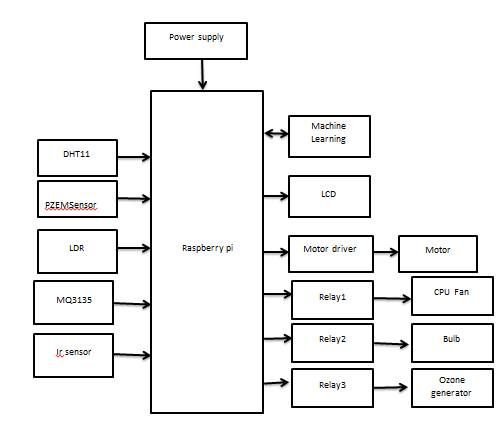
Specifications
Hardware Requirements:
- Raspberry Pi
- memory card
- lcd
- Arduino
- Pzem004t sensor
- Dht11
- Ldr sensor
- mq135 sensor
- ir sensor
- Motor driver
- dc motor
- relay-3
- cpu fan
- Bulb holder
- Bulb
- Mini ozone generator
- Power supply
- Adapter
Software Requirements:
- Python
- python IDE
Learning Outcomes
- Raspberry pi Pin diagram and Architecture
- How to install and setting up of python IDE
- MQ3135 interface with Raspberry pi
- DHT11 interface with Raspberry pi
- PZEM sensor interface with Raspberry pi
- LCD interface with Raspberry pi
- About Project Development Life Cycle:
- Planning and Requirement Gathering( software’s, Tools, Hardware components, etc.,)
- Schematic preparation
- Code development and debugging
- Hardware development and debugging
- Development of the Project and Output testing
- Practical exposure to:
- Hardware and software tools. ,
- Solution providing for real time problems,
- Working with team/ individual,
- Work on Creative ideas.
- Project development Skills
- Problem analyzing skills
- Problem solving skills
- Creativity and imaginary skills
- Programming skills
- Deployment
- Testing skills
- Debugging skills
- Project presentation skills
- Thesis writing skills


 Paper Publishing

Request Call Back
Would you like to receive a free callback now?
Choose the best time for callback:
Leave your message and we will contact you as soon as possible

6-2-85/B, Old Maternity Hospital Road, Thyagaraja Nagar, Tirupati, Andhra Pradesh – 517501
+91 9030333433
+91 9393939065
0877-2261612

Disclaimer - Takeoff Edu Group Projects are not associated or affiliated with IEEE in any way. The IEEE Projects mentioned here are mentioned in the context of student projects, whose ideas are derived from IEEE publications, not projects of or by IEEE.

