Device-Based Cellular Throughput Prediction for Video Streaming Lessons From a Real-World Evaluation
Objective
The objective of this project is to enhance the performance of adaptive video streaming by accurately predicting downlink throughput in mobile cellular networks. By leveraging machine learning algorithms, including Random Forest Regressor, XGBoost Regressor, LSTM, a hybrid model, and ExtraTrees Regressor, the project aims to address the challenges posed by network variability, device mobility, and diverse traffic demands. The goal is to develop models capable of predicting throughput with high accuracy using real-world traffic data. This would ultimately improve the Quality of Experience (QoE) for users, ensuring efficient resource allocation and optimized video streaming in dynamic network environments.
Abstract
Accurate prediction of downlink throughput in mobile cellular networks is critical for improving the quality of experience (QoE) in adaptive video streaming applications. With the growing demand for high-quality video content and the dynamic nature of wireless networks, predicting cellular throughput remains a challenging problem due to factors such as device mobility, diverse traffic patterns, and link variability. This study investigates the application of machine learning algorithms for throughput prediction, leveraging traffic traces collected from operational networks. We explore various algorithms, including Random Forest Regressor, XGBoost Regressor, Long Short-Term Memory (LSTM), a hybrid model combining multiple techniques, and ExtraTrees Regressor. The models are evaluated based on their predictive accuracy and ability to adapt to real-world network conditions, demonstrating the potential of AI-driven approaches for enhancing adaptive streaming systems. This work provides valuable insights into the practical deployment of machine learning for network performance optimization.
Keywords:
Cellular Throughput Prediction, Mobile Networks, Adaptive Video Streaming, Machine Learning, Random Forest Regressor, XGBoost Regressor, Long Short-Term Memory (LSTM), Hybrid Model, ExtraTrees Regressor, Quality of Experience (QoE), Traffic Traces and AI-driven Network Optimization.
NOTE: Without the concern of our team, please don't submit to the college. This Abstract varies based on student requirements.
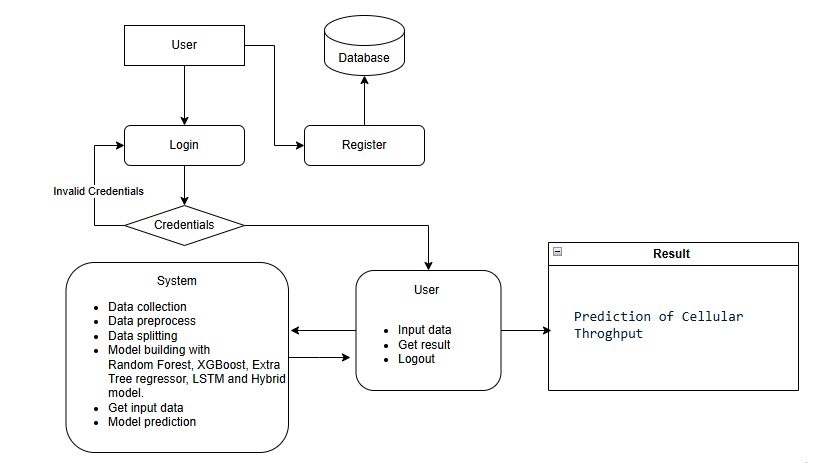
Block Diagram
Specifications
Hardware Requirements
Processor - I3/Intel Processor
Hard Disk - 160GB
Key Board - Standard Windows Keyboard
Mouse - Two or Three Button Mouse
Monitor - SVGA
RAM - 8GB
Software Requirements:
Operating System : Windows 7/8/10
Server side Script : HTML, CSS, Bootstrap & JS
Programming Language : Python
Libraries : Django, Pandas, Numpy, Tensorflow, Scikit-learn.
IDE/Workbench : VS Code
Technology : Python 3.10
Database : SQLite

Demo Video


Request for Video
 Paper Publishing
Request Call Back
Would you like to receive a free callback now?
Choose the best time for callback:
Leave your message and we will contact you as soon as possible

6-2-85/B, Old Maternity Hospital Road, Thyagaraja Nagar, Tirupati, Andhra Pradesh – 517501
+91 9030333433
+91 9393939065
0877-2261612

Disclaimer - Takeoff Edu Group Projects are not associated or affiliated with IEEE in any way. The IEEE Projects mentioned here are mentioned in the context of student projects, whose ideas are derived from IEEE publications, not projects of or by IEEE.

