Development Of Reverse Vending Machine (rvm) Framework For Implementation To A Standard Recycle Bin Using Raspberry Pi
Also Available Domains IOT|WSN|Embedded applications
Abstract
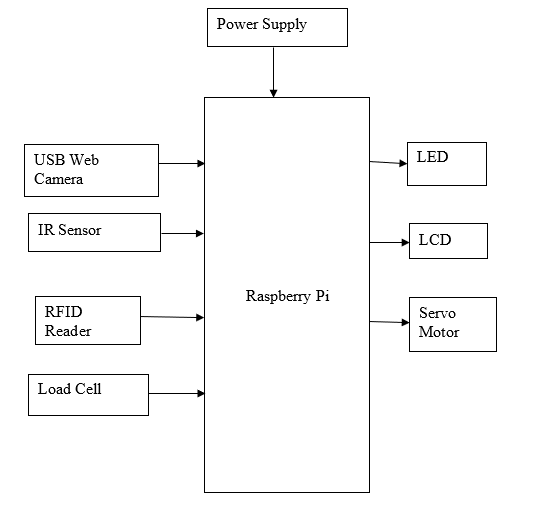
The increasing challenge of effective waste management has led to the development of innovative recycling solutions such as Reverse Vending Machines (RVMs). This project proposes a smart RVM framework that integrates with a standard recycle bin using a Raspberry Pi as the main controller. The system leverages a web camera for real-time object detection to identify recyclable items, while an IR sensor detects the presence of objects at the input point. A load cell is employed to verify the weight of the deposited items, ensuring only valid recyclables are accepted. For user incentives, an RFID module is used to credit rewards upon successful deposit. A servo motor automates the door mechanism to allow or restrict access based on object verification. The system features an LCD to display status messages and process updates, and colored LEDs provide visual indications throughout the operation. This smart RVM framework promotes sustainable recycling habits by offering a user-friendly and automated solution that can be seamlessly implemented on existing recycle bins.
NOTE: Without the concern of our team, please don't submit to the college. This Abstract varies based on student requirements.
Block Diagram
Specifications
Hardware Requirements:
- Raspberry Pi
- Power Supply
- Web Camera
- IR Sensor
- RFID Reader
- Load Cell
- Servo Motor
- LCD
- LED
Software Requirements:
- Raspbian OS
- Python
Learning Outcomes
- Raspberry Pi pin diagram and architecture
- How to install Raspberry Pi OS and setup environment
- Setting up and installation procedure for Raspberry Pi
- Introduction to Raspberry Pi OS and terminal interface
- Basic coding using Python on Raspberry Pi
- Basics of Embedded Linux systems
- Basics of IoT platforms
- Working of power supply
About Project Development Life Cycle:
- Planning and Requirement Gathering (software, tools, hardware components, etc.)
- Schematic preparation
- Code development and debugging
- Hardware development and debugging
- Development of the project and output testing
Practical exposure to:
- Hardware and software tools
- Solution providing for real-time problems
- Working with team/individual
- Work on creative ideas
Project Development Skills:
- Problem analysing skills
- Problem solving skills
- Creativity and imagination skills
- Programming skills
- Deployment
- Testing skills
- Debugging skills
- Project presentation skills
Thesis writing skills


 Paper Publishing

Request Call Back
Would you like to receive a free callback now?
Choose the best time for callback:
Leave your message and we will contact you as soon as possible

6-2-85/B, Old Maternity Hospital Road, Thyagaraja Nagar, Tirupati, Andhra Pradesh – 517501
+91 9030333433
+91 9393939065
0877-2261612

Disclaimer - Takeoff Edu Group Projects are not associated or affiliated with IEEE in any way. The IEEE Projects mentioned here are mentioned in the context of student projects, whose ideas are derived from IEEE publications, not projects of or by IEEE.

