Development of Progressive Fuzzy Logic and ANFIS Control for Energy Management of Plug-In Hybrid Electric Vehicle
Objective
The main objective for this project is to develop a progressive Adaptive Neuro-Fuzzy Inference System (ANFIS)-based control strategy for efficient energy management in Plug-in Hybrid Electric Vehicles (PHEVs), aiming to optimize power distribution between energy sources, enhance fuel economy, and improve overall system performance under dynamic driving conditions
Abstract
In this project presents a Hybrid electric vehicles (HEVs) offer a promising alternative to conventional fuel-powered vehicles, with efficient and intelligent energy management being a key factor in their widespread global adoption. Recent advancements in intelligent control techniques, coupled with the growing need for smarter energy systems, have accelerated the development of energy-efficient HEVs. Energy management plays a critical role in improving the autonomy and reducing the operational cost of plug-in hybrid electric vehicles (PHEVs). To address this, a novel approach employing intelligent control strategies is proposed to manage energy distribution in PHEVs under varying driver behavior and load profiles. This paper focuses on enhancing battery performance using a Adaptive Neuro-Fuzzy Inference System (ANFIS), with the battery’s State of Charge (SOC) serving as the primary decision-making parameter. Engine speed and SOC are used as inputs, based on which the controller determines the appropriate torque required for energy conversion and battery charging. This is achieved by adjusting the forward gain value through intelligent control logic. Two advanced controllers—FLC and ANFIS—are implemented to determine the optimal forward gain, and the system performance is simulated using MATLAB/Simulink. The results from both control methods are analysed and compared to identify the more effective technique for efficient energy management in PHEVs. The findings demonstrate that advanced intelligent control methods significantly improve vehicle performance and contribute to better fuel economy in hybrid electric vehicles.
Keywords: Artificial intelligence, artificial neural network, energy management strategy, fuzzy logic, hybrid electric vehicles.
NOTE: Without the concern of our team, please don't submit to the college. This Abstract varies based on student requirements.
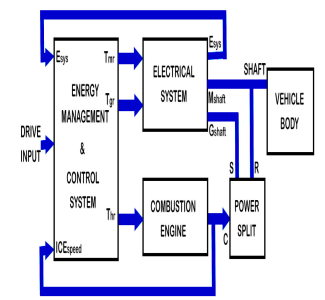
Block Diagram
Specifications
Software Configuration:
Operating System : Windows 7/8/10
Application Software: Matlab/Simulink
Hardware Configuration:
RAM : 8 GB / 4 GB (Min)
Processor : I3 / I5 (Mostly prefer)
Learning Outcomes
· Introduction to Matlab/Simulink
· What is EISPACK & LINPACK
· How to start with MATLAB
· About Matlab language
· About tools & libraries
· Application of Matlab/Simulink
· About Matlab desktop
· Features of Matlab/Simulink
· Basics on Matlab/Simulink
· Introduction to electric vechicles
· Introduction to power train models
· Design of ev vechicles
· Introduction to combustion engine
· Introduction to generator
· Introduction to motor
· Project Development Skills:
o Problem analyzing skills
o Problem solving skills
o Creativity and imaginary skills
o Programming skills
o Deployment
o Testing skills
o Debugging skills
o Project presentation skills
o Thesis writing skills
Demo Video


Request for Video
Related Projects
 Paper Publishing
Request Call Back
Would you like to receive a free callback now?
Choose the best time for callback:
Leave your message and we will contact you as soon as possible

6-2-85/B, Old Maternity Hospital Road, Thyagaraja Nagar, Tirupati, Andhra Pradesh – 517501
+91 9030333433
+91 9393939065
0877-2261612

Disclaimer - Takeoff Edu Group Projects are not associated or affiliated with IEEE in any way. The IEEE Projects mentioned here are mentioned in the context of student projects, whose ideas are derived from IEEE publications, not projects of or by IEEE.

