Development of Automated Nutrient Composition Control for Fertigation System Using IoT Application
Objective
The main objective of this project is to create an automated nutrient composition control for a fertigation system using IoT application
Abstract
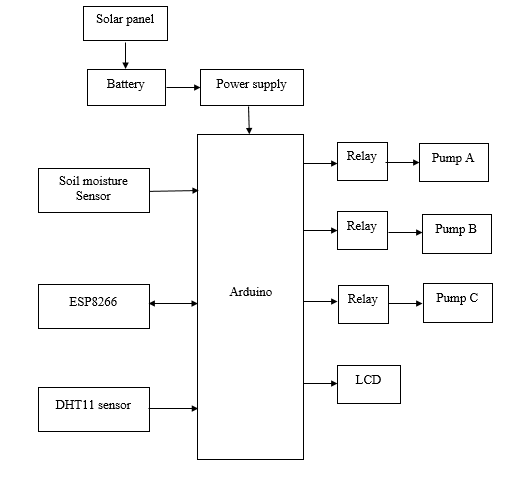
This project introduces solution for automated nutrient mixing fertigation system control, leveraging the capabilities of IOT technology. The central components of this system comprise three separate buckets—one for each fertilizer (A and B) and one for water. These buckets are utilized to create the nutrient mixture, which is then transported to the plants via a motor-driven distribution system. A soil moisture sensor plays a pivotal role in detecting the moisture levels in the soil, and when necessary, it triggers the release of water from the dedicated water bucket to nourish the plants. Additionally, a DHT11 sensor continuously measures the ambient temperature to ensure optimal growing conditions.
Solar panel, coupled with a rechargeable battery and a 5V power supply. This energy-efficient setup ensures the system's seamless operation while minimizing environmental impact. The collected data, including moisture levels and temperature, is wirelessly transmitted to a Node MCU ESP8266 module, which seamlessly integrates with the Blynk application, forming a robust Internet of Things (IOT) ecosystem. This IOT integration empowers users to remotely monitor and adjust the nutrient composition and irrigation process, ensuring that plants receive the ideal combination of nutrients and moisture for optimal growth and health.
Keywords:
Internet of Things, Automated fertigation system, solar power, IOT application
NOTE: Without the concern of our team, please don't submit to the college. This Abstract varies based on student requirements.
Block Diagram
Specifications
Hardware Components:
- Arduino
- Solar Panel
- 5v power supply
- Battery
- Relay - 3
- Soil Moisture Sensor
- DHT11 Sensor
- ESP8266
- Pumps - 3
Software Components:
- Arduino IDE
- Embedded C
Learning Outcomes
- Introduction to Microcontroller
- Microcontroller pin diagram and architecture
- Basic Coding
- Introduction to Embedded Software
- Interfacing LCD with microcontroller
- Working of power supply
- Working of rectifier
- About Project Development Life Cycle
- Planning and Requirement Gathering (software’s, Tools, Hardware components, etc.,)
- Schematic preparation
- Code development and debugging
- Hardware development and debugging
- Development of the Project and Output testing
- Practical exposure to
- Hardware and software tools.
- Solution providing for real time problems.
- Working with team individual.
- Work on Creative ideas.
- Project development Skills
- Problem analyzing skills
- Problem solving skills
- Creativity and imaginary skills
- Programming skills
- Deployment
- Testing skills
- Debugging skills
- Project presentation skills


 Paper Publishing

Request Call Back
Would you like to receive a free callback now?
Choose the best time for callback:
Leave your message and we will contact you as soon as possible

6-2-85/B, Old Maternity Hospital Road, Thyagaraja Nagar, Tirupati, Andhra Pradesh – 517501
+91 9030333433
+91 9393939065
0877-2261612

Disclaimer - Takeoff Edu Group Projects are not associated or affiliated with IEEE in any way. The IEEE Projects mentioned here are mentioned in the context of student projects, whose ideas are derived from IEEE publications, not projects of or by IEEE.

