Development of an IoT Based Photovoltaic Monitoring System Using Hybrid Modeling
Objective
The objective of this project is to create an IoT-based Photovoltaic Monitoring System that employs hybrid modeling techniques, aiming to enhance the efficiency and performance of photovoltaic systems through real-time data collection
Abstract
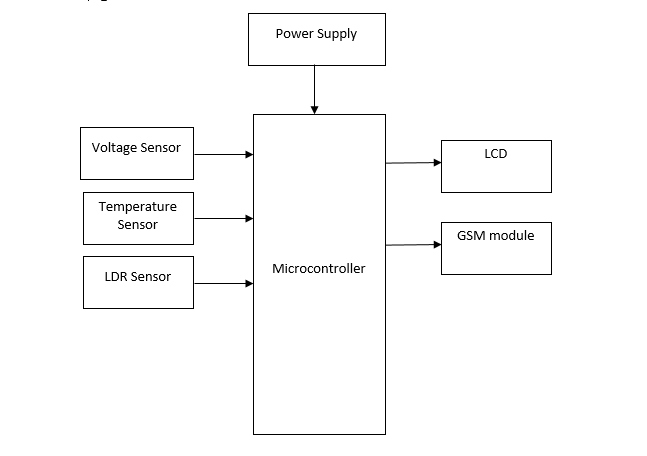
This abstract introduces a comprehensive Photovoltaic Monitoring System designed to enhance the efficiency and reliability of solar energy generation. The system leverages Raspberry Pi as its central controller and integrates various sensors to monitor critical parameters, including voltage, temperature, and light intensity. The system's functionality begins with the interfacing of sensors with the Raspberry Pi. Voltage sensors continuously monitor the electrical output of the photovoltaic panels, allowing for precise tracking of the power generated. Temperature sensors provide information about the operating temperature of the panels, a critical factor affecting their efficiency. Light Dependent Resistor (LDR) sensors measure the light intensity, enabling the system to assess the available solar irradiance.
To optimize power generation and ensure the panels operate within their ideal conditions, the collected sensor data is uploaded to a linear regression model. This model analyses historical and present data to predict the expected power output. The model's predictions are then compared to the actual power generated by the photovoltaic panels. To further enhance system reliability, the monitoring system is equipped to detect anomalies or discrepancies between the predicted and actual power outputs. When such anomalies are identified, an SMS alert is generated using a GSM module. This alert system provides immediate notification to relevant personnel, enabling them to take corrective action promptly, such as investigating and rectifying issues affecting the solar panel performance.
Keywords: Photovoltaic, Solar Energy, Power Generation. Linear Regression, GSM module
NOTE: Without the concern of our team, please don't submit to the college. This Abstract varies based on student requirements.
Block Diagram
Specifications
Hardware Requirements:
- Raspberry pi
- GSM module
- Temperature Sensor
- Voltage Sensor
- LDR Sensor
- Power Supply
- Buzzer
- LCD
Software Requirements:
- Raspbian OS
- Python
Learning Outcomes
- Introduction to Microcontroller
- Microcontroller pin diagram and architecture
- Basic Coding
- Introduction to Embedded Software
- Interfacing LCD with microcontroller
- Working of power supply
- Working of rectifier
- About Project Development Life Cycle
- Planning and Requirement Gathering (software’s, Tools, Hardware components, etc.,)
- Schematic preparation
- Code development and debugging
- Hardware development and debugging
- Development of the Project and Output testing
- Practical exposure to
- Hardware and software tools.
- Solution providing for real time problems.
- Working with team individual.
- Work on Creative ideas.
- Project development Skills
- Problem analyzing skills
- Problem solving skills
- Creativity and imaginary skills
- Programming skills
- Deployment
- Testing skills
- Debugging skills
- Project presentation skills


 Paper Publishing

Request Call Back
Would you like to receive a free callback now?
Choose the best time for callback:
Leave your message and we will contact you as soon as possible

6-2-85/B, Old Maternity Hospital Road, Thyagaraja Nagar, Tirupati, Andhra Pradesh – 517501
+91 9030333433
+91 9393939065
0877-2261612

Disclaimer - Takeoff Edu Group Projects are not associated or affiliated with IEEE in any way. The IEEE Projects mentioned here are mentioned in the context of student projects, whose ideas are derived from IEEE publications, not projects of or by IEEE.

