Development of An Automated IoT-based Fish Tank Maintenance Assistive System
Objective
The main objective of this project is to develop an automated IoT-based fish tank maintenance system for optimal water quality, temperature control, and feeding
Abstract
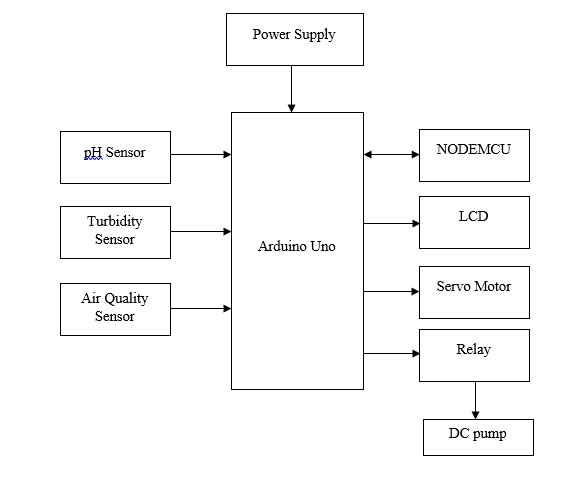
In this project, we present the design and implementation of an Arduino-based fish tank monitoring system that utilizes turbidity and pH sensors, along with a servo motor for automated water quality management. The system aims to provide monitoring and control capabilities to ensure optimal conditions for aquatic life in a fish tank environment. The turbidity sensor measures the cloudiness or clarity of the water, which is crucial for assessing the presence of suspended particles and overall water quality. The pH sensor measures the acidity or alkalinity of the water, providing valuable information about the tank's chemical balance. The air quality sensor present in the system helps to measure the air quality in the environment. To ensure the stability of water conditions, the system employs a servo motor that controls fish food. And LCD will able to give visual feedback.
The Arduino acts as the central processing unit of the system, responsible for collecting sensor data, analysing it, and executing appropriate control actions. By leveraging its digital and analog input/output capabilities, the Arduino effectively interfaces with the turbidity and pH sensors, as well as the servo motor, enabling communication and control. And also a nodeMCU will work as bridge between arduino and web server and also provide controlling the fish feed whenever needed. And the DC pump which connected through relay will help to change the water if necessary based on sensor data.
The fish tank monitoring system presented in this project demonstrates an effective and versatile solution for maintaining optimal water conditions in aquariums or fish tanks. By integrating turbidity and pH sensors with an Arduino microcontroller, along with servo motor control, the system offers an user-friendly approach to fish tank management.
Keywords: pH sensor, servo motor, turbidity sensor, nodemcu, arduino.
NOTE: Without the concern of our team, please don't submit to the college. This Abstract varies based on student requirements.
Block Diagram
Specifications
Hardware Requirements:
- Arduino UNO
- Air Quality sensor
- pH sensor
- Turbidity sensor
- DC pump
- Buzzer
- Power Supply
- Relay
- Servo motor
- NodeMCU
- LCD
Software Requirements:
- Arduino IDE
- Embedded C
Learning Outcomes
- Arduino pin diagram and architecture
- How to install Arduino IDE software
- Setting up and installation procedure for Arduino
- Introduction to Arduino IDE
- Basic coding in Arduino IDE
- Working of LCD
- Interface LCD with Arduino
- Working of power supply
- About Project Development Life Cycle
- Planning and Requirement Gathering (software’s, Tools, Hardware components, etc.,)
- Schematic preparation
- Code development and debugging
- Hardware development and debugging
- Development of the Project and Output testing
- Practical exposure to
- Hardware and software tools.
- Solution providing for real time problems.
- Working with team individual.
- Work on Creative ideas.
- Project development Skills
- Problem analyzing skills
- Problem solving skills
- Creativity and imaginary skills
- Programming skills
- Deployment
- Testing skills
- Debugging skills
- Project presentation skills


 Paper Publishing

Request Call Back
Would you like to receive a free callback now?
Choose the best time for callback:
Leave your message and we will contact you as soon as possible

6-2-85/B, Old Maternity Hospital Road, Thyagaraja Nagar, Tirupati, Andhra Pradesh – 517501
+91 9030333433
+91 9393939065
0877-2261612

Disclaimer - Takeoff Edu Group Projects are not associated or affiliated with IEEE in any way. The IEEE Projects mentioned here are mentioned in the context of student projects, whose ideas are derived from IEEE publications, not projects of or by IEEE.

