Development of an Adaptive and Explainable IIoT Intrusion Detection System Using Novel Ensemble Techniques
Objective
The main objective of this project is to develop an adaptive and explainable intrusion detection system for IIoT networks using the X-IIoTID dataset. The system aims to accurately classify 19 attack and normal classes by applying advanced machine learning techniques such as attention-weighted ensemble learning, stacked generalization, and hierarchical feature clustering. It also integrates SHAP explainability to provide transparent predictions and ADWIN-based concept drift detection for continual learning and model adaptation. The project focuses on improving detection accuracy, handling class imbalance through balanced preprocessing, and delivering reliable confidence scores. Additionally, a Flask-based web application is developed to allow secure user interaction, feature input, and real-time intrusion classification.
Abstract
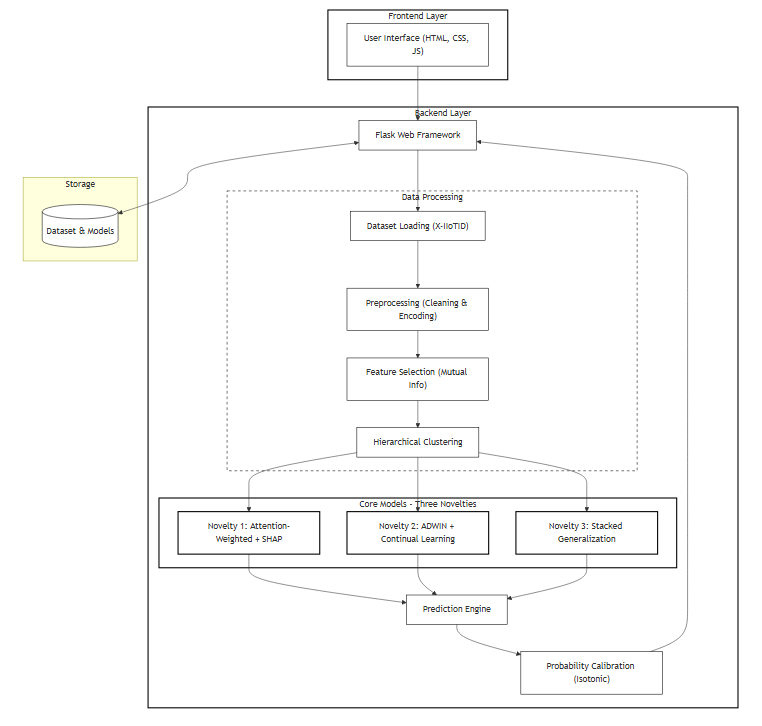
This project presents an intrusion detection system for IIoT networks using the X-IIoTID dataset. The system applies three novel approaches to improve classification accuracy across 19 attack and normal classes. The first novelty introduces an attention-weighted ensemble combined with SHAP for explainable predictions. The second novelty adds concept drift detection using ADWIN to support continual learning and model updates. The third novelty uses hierarchical feature clustering with stacked generalization, where specialist tree models handle feature groups and a meta-learner combines their outputs with isotonic calibration.
The web-based application allows users to register, login, perform classification on network traffic features, and view results with confidence scores. Preprocessing includes feature selection via mutual information and exact balancing to 5000 samples per class. Experiments show high performance with accuracy above 99% on the test set. The Flask-based system provides an easy interface for model interaction while maintaining strong detection capabilities.
Keywords: IIoT intrusion detection, X-IIoTID dataset, stacked generalization, hierarchical clustering, attention-weighted ensemble, concept drift detection, continual learning, SHAP explainability, mutual information selection, ensemble calibration.
NOTE: Without the concern of our team, please don't submit to the college. This Abstract varies based on student requirements.
Block Diagram
Specifications
5.2 Hardware Requirements
Processor - I3/Intel Processor
Hard Disk - 160GB
Key Board - Standard Windows Keyboard
Mouse - Two or Three Button Mouse
Monitor - SVGA
RAM - 8GB
5.3 Software Requirements
• Operating System : Windows 7/8/10
• Programming Language : Python
• Libraries : Pandas, Numpy, scikit-learn.
• IDE/Workbench : Visual Studio Code.


 Paper Publishing

Request Call Back
Would you like to receive a free callback now?
Choose the best time for callback:
Leave your message and we will contact you as soon as possible

6-2-85/B, Old Maternity Hospital Road, Thyagaraja Nagar, Tirupati, Andhra Pradesh – 517501
+91 9030333433
+91 9393939065
0877-2261612

Disclaimer - Takeoff Edu Group Projects are not associated or affiliated with IEEE in any way. The IEEE Projects mentioned here are mentioned in the context of student projects, whose ideas are derived from IEEE publications, not projects of or by IEEE.

