Developing Fish Feeder System Using Raspberry Pi
Also Available Domains Industrial Automation|Embedded applications
Abstract
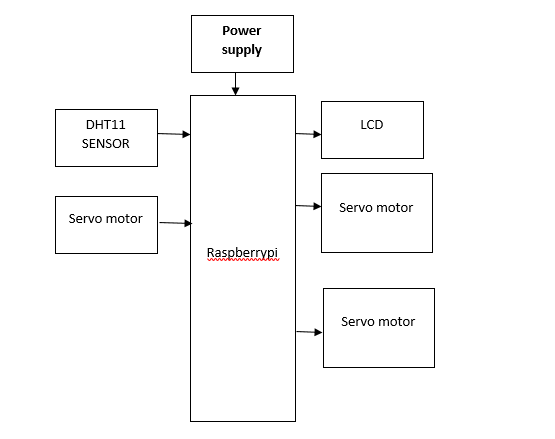
This project presents the development of an automated fish feeder system using Raspberry Pi, designed to monitor and maintain optimal conditions in an aquarium while ensuring timely feeding. The system integrates a DHT11 sensor to measure temperature and humidity, and a pH sensor to monitor water quality. These environmental parameters are continuously tracked and displayed on an LCD screen. If any readings fall outside the predefined safe range, the system activates a buzzer and sends an alert message to the user via a GSM module. For feeding automation, the system allows the user to set a specific feeding time. When the current time matches the preset time, the Raspberry Pi activates a servo motor to dispense food into the aquarium. This smart feeder not only maintains a healthy aquatic environment but also ensures consistent and timely feeding, reducing manual intervention and promoting better fish care.
NOTE: Without the concern of our team, please don't submit to the college. This Abstract varies based on student requirements.
Block Diagram
Specifications
Hardware requirements:
- Raspberry pi
- LCD
- DHT11 Sensor
- Ph scale
- GSM
- Servo motor
- Power supply
Software requirements:
- Raspian os
- Python
Learning Outcomes
- Raspberry pi pin diagram and architecture
- How to install Raspberry pi IDE software
- Setting up and installation procedure for Raspbian
- Basic coding in Raspbian
- Basic of python language
- Working of DHT 11 Sensor
- How to interface ph scale with Raspberry pi?
- Working of Servo motor
- Working of GSM
- Working of LCD
- How to interface LCD with Arduino?
- About Project Development Life Cycle:
- Planning and Requirement Gathering (software’s, Tools, Hardware components, etc.,)
- Schematic preparation
- Code development and debugging
- Hardware development and debugging
- Development of the Project and Output testing
- Practical exposure to:
- Hardware and software tools.
- Solution providing for real time problems.
- Working with team/ individual.
- Work on Creative ideas.
- Project development Skills
- Problem analyzing skills
- Problem solving skills
- Creativity and imaginary skills
- Programming skills
- Deployment
- Testing skills
- Debugging skills
- Project presentation skills
- Thesis writing skills


 Paper Publishing

Request Call Back
Would you like to receive a free callback now?
Choose the best time for callback:
Leave your message and we will contact you as soon as possible

6-2-85/B, Old Maternity Hospital Road, Thyagaraja Nagar, Tirupati, Andhra Pradesh – 517501
+91 9030333433
+91 9393939065
0877-2261612

Disclaimer - Takeoff Edu Group Projects are not associated or affiliated with IEEE in any way. The IEEE Projects mentioned here are mentioned in the context of student projects, whose ideas are derived from IEEE publications, not projects of or by IEEE.

