Determining species of bird using there voice
Objective
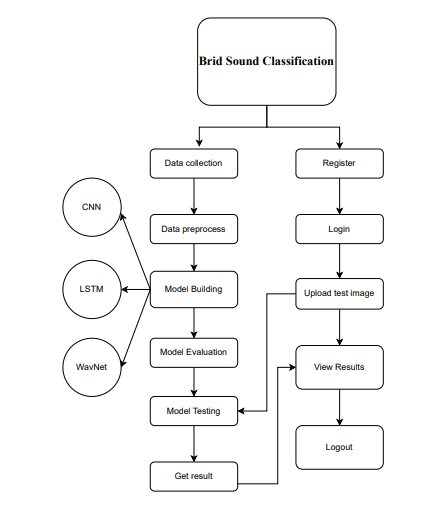
The objective of this project is to develop an accurate machine learning model for identifying bird species using their vocalizations. This involves curating a dataset that includes species with sufficient audio samples to ensure effective training. We aim to implement advanced algorithms, such as CNN, LSTM, and WavNet, alongside robust feature extraction techniques like MFCCs and data augmentation methods to enhance model performance. Ultimately, the project seeks to provide a reliable tool for automatic bird species recognition, contributing to ecological studies, conservation efforts, and fostering greater awareness of avian biodiversity through automated audio analysis.
Abstract
This project focuses on developing a machine learning model to identify bird species based on their vocalizations. Given the challenges posed by datasets with imbalanced class distributions, the aim is to curate a selection of bird species that have sufficient audio samples for effective model training. We utilize advanced algorithms, including Convolutional Neural Networks (CNN), Long Short-Term Memory (LSTM) networks, and WavNet, alongside comprehensive feature extraction techniques. The audio features extracted include zero-crossing rate, root mean square energy, and Mel-frequency cepstral coefficients (MFCCs), which are pivotal for distinguishing vocal characteristics among species. The model's performance is enhanced through data augmentation strategies, such as noise addition and pitch shifting, to increase the diversity of training samples. This approach allows for robust classification, even with a limited number of audio recordings per species. Ultimately, our model demonstrates the potential to accurately predict bird species based on audio input, contributing to biodiversity studies and ecological monitoring efforts.
Keywords: Bird Sound Recognition, Machine Learning, CNN, LSTM, WavNet, Feature Extraction, Zero-Crossing Rate, Root Mean Square (RMS) Energy, MFCCs, Data Augmentation, Noise Addition, Pitch Shifting, Species Classification.
NOTE: Without the concern of our team, please don't submit to the college. This Abstract varies based on student requirements.
Block Diagram
Specifications
Hardware Requirements
Processor - I7/Intel Processor
Hard Disk - 160GB
Key Board - Standard Windows Keyboard
Mouse - Two or Three Button Mouse
Monitor - SVGA
RAM - 8GB
Software Requirements:
Operating System : Windows 11
Server side Script : HTML, CSS, Bootstrap & JS
Programming Language : Python
Libraries : Flask, Pandas, Mysql.connector, Os, Smtplib, Numpy
IDE/Workbench : PyCharm
Technology : Python 3.6+

Demo Video


Request for Video
 Paper Publishing
Request Call Back
Would you like to receive a free callback now?
Choose the best time for callback:
Leave your message and we will contact you as soon as possible

6-2-85/B, Old Maternity Hospital Road, Thyagaraja Nagar, Tirupati, Andhra Pradesh – 517501
+91 9030333433
+91 9393939065
0877-2261612

Disclaimer - Takeoff Edu Group Projects are not associated or affiliated with IEEE in any way. The IEEE Projects mentioned here are mentioned in the context of student projects, whose ideas are derived from IEEE publications, not projects of or by IEEE.

