Detection of Cyber Attacks Using Artificial Intelligence
Objective
The primary goal of this project is to determine the cyber-attack whether there will be attack or not and to know this we have used the Support Vector , Decision Tree, Random forest, Extra Tree Classifier and ad boost and neural network classifier classification techniques.
Abstract
Cyber-physical systems(cps) have made significant progress in many dynamic applications due to the integration between physical processes, computational resources, and communication capabilities. However, cyber-attacks are a major threat to these systems. Unlike faults that occurs by accidents cyber-physical systems, cyber-attacks occur intelligently and stealthy. Some of these attacks which are called deception attacks, inject false data from sensors or controllers, and also by compromising with some cyber components, corrupt data, or enter misinformation into the system. If the system is unaware of the existence of these attacks, it won’t be able to detect them, and performance may be disrupted or disabled altogether. Therefore, it is necessary to adapt algorithms to identify these types of attacks in these systems. It should be noted that the data generated in these systems is produced in very large number, with so much variety, and high speed, so it is important to use machine learning algorithms to facilitate the analysis and evaluation of data and to identify hidden patterns. In this research, the CPS is modeled as a network of agents that move in union with each other, and one agent is considered as a leader, and the other agents are commanded by the leader. The proposed method in this study is to use the structure of deep neural networks for the detection phase, which should inform the system of the existence of the attack in the initial moments of the attack. The use of resilient control algorithms in the network to isolate the misbehave agent in the leader-follower mechanism has been investigated. In the presented control method, after the attack detection phase with the use of a deep neural network, the control system uses the reputation algorithm to isolate the misbehave agent. Experimental analysis shows us that deep learning algorithms can detect attacks with higher performance that usual methods and can make cyber security simpler, more proactive, less expensive and far more effective.
NOTE: Without the concern of our team, please don't submit to the college. This Abstract varies based on student requirements.
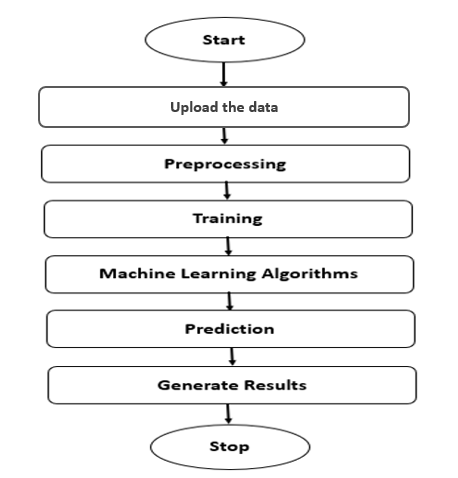
Block Diagram
Specifications
Hardware:
- Operating system: Windows 7 or 7+
- RAM : 8 GB
- Hard disc or SSD : More than 500 GB
- Processor: Intel 3rd generation or high or Ryzen with 8 GB Ram
Software:
- Software’s : Python 3.6 or high version
- IDE: PyCharm.
- Framework: Flask
Learning Outcomes
· Practical exposure to
· Hardware and software tools
· Solution providing for real time problems
· Working with team/individual
· Work on creative ideas
· Testing techniques
· Error correction mechanisms
· What type of technology versions is used?
· Working of Tensor Flow
· Implementation of Deep Learning techniques
· Working of CNN algorithm
· Working of Transfer Learning methods
· Building of model creations
· Scope of project
· Applications of the project
· About Python language
· About Deep Learning Frameworks
Use of Data Science


 Paper Publishing

Request Call Back
Would you like to receive a free callback now?
Choose the best time for callback:
Leave your message and we will contact you as soon as possible

6-2-85/B, Old Maternity Hospital Road, Thyagaraja Nagar, Tirupati, Andhra Pradesh – 517501
+91 9030333433
+91 9393939065
0877-2261612

Disclaimer - Takeoff Edu Group Projects are not associated or affiliated with IEEE in any way. The IEEE Projects mentioned here are mentioned in the context of student projects, whose ideas are derived from IEEE publications, not projects of or by IEEE.

