Detection of Anomalous Behavior of Smartphone Devices using Change Point Analysis & Machine Learning
Objective
The primary goal of this project is to determine the anomalous behavior whether there is anomalous behavior or not and to know this we have used Decision tree, XG Boosting and AdaBoost Classifiers and Support Vector Classifier to classify anomalous behavior.
Abstract
Security, reliability, and availability have become three fundamental characteristics that smartphones and IoT (Internet of Things) devices have to possess to provide end-users a trustworthy experience. These properties can be degraded by extraneous events or anomalous behavior provoking damage in hardware, changes in software, theft of user information, and impact of device performance in terms of speed or availability. Considering these facts, this paper focuses on anomaly detection on smartphones using their power consumption signals. These signals represent the dynamic behavior of the device due to the action of different hardware components controlled by one or many applications at the same time. This behavior can be seen as a non-stationary process due to the changes in time of its statistical properties. Considering this assumption, our methodology uses a feature extraction technique that is based on changepoint detection theory. Then, it fits three machine learning classifiers to inject diversity and maximize the detection performance. The methodology was validated on a dataset of an emulated malware running in the background of a smartphone. Our results have been compared with several power signal based approaches demonstrating that the proposed technique performs better in terms of detection accuracy.
Keywords: Anomalous Behaviour, Decision tree, XGBoosting and AdaBoost Classifiers and Support Vector Classifier.
NOTE: Without the concern of our team, please don't submit to the college. This Abstract varies based on student requirements.
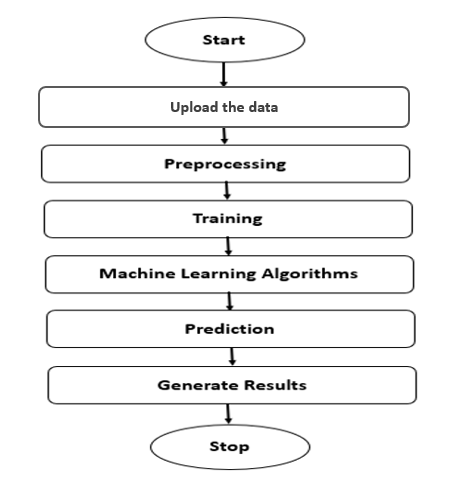
Block Diagram
Specifications
Hardware:
- Operating system : Windows 7 or 7+
- RAM: 8 GB
- Hard disc or SSD: More than 500 GB
- Processor : Intel 3rd generation or high or Ryzen with 8 GB Ram
Software:
- Software’s: Python 3.6 or high version
- IDE: PyCharm.
- Framework: Flask
Learning Outcomes
· Practical exposure to
· Hardware and software tools
· Solution providing for real time problems
· Working with team/individual
· Work on creative ideas
· Testing techniques
· Error correction mechanisms
· What type of technology versions is used?
· Working of Tensor Flow
· Implementation of Deep Learning techniques
· Working of CNN algorithm
· Working of Transfer Learning methods
· Building of model creations
· Scope of project
· Applications of the project
· About Python language
· About Deep Learning Frameworks
Use of Data Science


 Paper Publishing

Request Call Back
Would you like to receive a free callback now?
Choose the best time for callback:
Leave your message and we will contact you as soon as possible

6-2-85/B, Old Maternity Hospital Road, Thyagaraja Nagar, Tirupati, Andhra Pradesh – 517501
+91 9030333433
+91 9393939065
0877-2261612

Disclaimer - Takeoff Edu Group Projects are not associated or affiliated with IEEE in any way. The IEEE Projects mentioned here are mentioned in the context of student projects, whose ideas are derived from IEEE publications, not projects of or by IEEE.

