Detecting Human Life During Fire
Objective
The primary objective of this project is to develop a robust detection system capable of accurately identifying humans, fire, and smoke in real-time using advanced deep learning algorithms, specifically YOLOv8 and YOLOv9. The project aims to implement an application that processes both uploaded images and live camera feeds, facilitating immediate alerts in emergency situations. Additionally, it seeks to evaluate and compare the performance of YOLOv8 and YOLOv9 in terms of accuracy and detection speed under varying conditions. Ultimately, the project strives to enhance safety and response measures in environments prone to fire hazards and emergencies.
Abstract
ABSTRACT
This project focuses on the development and evaluation of a robust detection system for identifying humans, fire, and smoke in real-time using advanced deep learning algorithms YOLOv8 and YOLOv9. Leveraging a dataset from Roboflow that contains a variety of images featuring these elements, we aim to implement a model that accurately detects and classifies the presence of humans, fire, and smoke in uploaded images and live camera feeds.The system will be developed in Python using Google Colab as the integrated development environment. By employing the capabilities of YOLOv8 and YOLOv9, we will compare their performance in terms of accuracy, speed, and robustness in various detection scenarios. The model will be capable of processing images from a laptop camera, although we acknowledge potential limitations due to the camera's resolution and clarity, which may affect detection accuracy.The expected outcome is a functional application that provides real-time alerts and visual feedback when fire, smoke, or human presence is detected, enhancing safety and response measures in critical situations. This project aims to contribute to the growing field of computer vision and its applications in safety and security systems.
Keywords: Real-time detection system, humans, fire, smoke, YOLOv8, YOLOv9, deep learning, Roboflow dataset, image classification, live camera feeds, Python, Google Colab, accuracy, speed, safety, security, computer vision.
NOTE: Without the concern of our team, please don't submit to the college. This Abstract varies based on student requirements.
Block Diagram
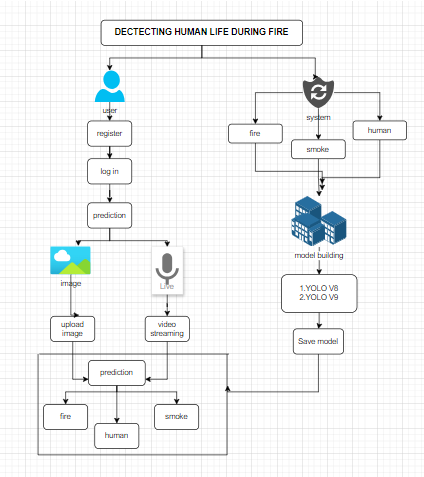
Specifications
HARDWARE & SOFTWARE REQUIREMENTS
SOFTWARE REQUIREMENS
Operating System : Windows 7/8/10
Server side Script : HTML, CSS, Bootstrap & JS
Programming Language : Python
Libraries :Flask, Torch, Tensorflow, Pandas, Mysql.connector
IDE/Workbench : VSCode
Server Deployment : Xampp Server
Database : MySQL
HARDWARE REQUIREMENTS
Processor I3/Intel Processor
RAM 8GB (min)
Hard Disk 128 GB
Key Board Standard Windows Keyboard
Mouse Two or Three Button Mouse
Monitor Any


 Paper Publishing

Request Call Back
Would you like to receive a free callback now?
Choose the best time for callback:
Leave your message and we will contact you as soon as possible

6-2-85/B, Old Maternity Hospital Road, Thyagaraja Nagar, Tirupati, Andhra Pradesh – 517501
+91 9030333433
+91 9393939065
0877-2261612

Disclaimer - Takeoff Edu Group Projects are not associated or affiliated with IEEE in any way. The IEEE Projects mentioned here are mentioned in the context of student projects, whose ideas are derived from IEEE publications, not projects of or by IEEE.

