Detecting Deepfake Audio Using Spectrogram-Based Machine Learning Approaches
Objective
The primary objective of this project is to develop a robust and efficient system for detecting deepfake audio using spectrogram-based machine learning approaches. By transforming audio samples into mel-spectrograms, the system captures rich time-frequency patterns essential for distinguishing synthetic speech from genuine recordings. The project leverages ensemble learning models—MobileNetV2, DenseNet121, and EfficientNetB0—to classify audio inputs based on their spectrogram features. Trained on the Deep Voice dataset containing both real and deepfake audio, the goal is to achieve high accuracy in detecting manipulations, thereby enhancing audio forensics, strengthening digital security, and mitigating the risks posed by AI-generated synthetic voices.
Abstract
The rapid advancement of deep learning technologies has led to the creation of highly convincing synthetic speech, raising significant concerns in areas such as digital security, media authenticity, and privacy. In response to this emerging threat, this work proposes a spectrogram-based machine learning framework for detecting deepfake audio. The approach involves converting audio signals into mel-spectrogram representations to capture essential time-frequency features, which are then used as input to three ensemble learning classifiers: MobileNetV2, DenseNet121, and EfficientNetB0. These models are trained and evaluated on the Deep Voice dataset, which comprises both real and synthetic voice samples. Experimental results demonstrate the effectiveness of the proposed method in distinguishing deepfake audio with high accuracy. This study underscores the potential of leveraging visual feature extraction techniques in combination with deep learning models for enhancing audio-based forgery detection systems.
Keywords: Deepfake Audio, Mel-Spectrogram, Audio Forensics, MobileNetV2, DenseNet121, EfficientNetB0, Deep Voice Dataset, Synthetic Speech Detection, Machine Learning, Ensemble Learning.
NOTE: Without the concern of our team, please don't submit to the college. This Abstract varies based on student requirements.
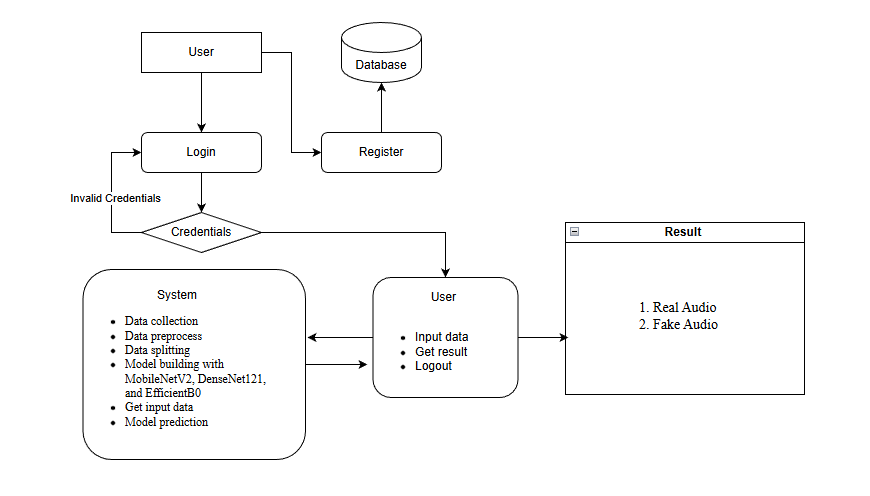
Block Diagram
Specifications
Hardware Requirements
Processor - I3/Intel Processor
Hard Disk - 160GB
Key Board - Standard Windows Keyboard
Mouse - Two or Three Button Mouse
Monitor - SVGA
RAM - 8GB
Software Requirements:
Operating System : Windows 7/8/10
Server side Script : HTML, CSS, Bootstrap & JS
Programming Language : Python
Libraries : Django, Pandas, Numpy, Tensorflow, Scikit-learn.
IDE/Workbench : VS Code
Technology : Python 3.10
Database : SQLite


 Paper Publishing

Request Call Back
Would you like to receive a free callback now?
Choose the best time for callback:
Leave your message and we will contact you as soon as possible

6-2-85/B, Old Maternity Hospital Road, Thyagaraja Nagar, Tirupati, Andhra Pradesh – 517501
+91 9030333433
+91 9393939065
0877-2261612

Disclaimer - Takeoff Edu Group Projects are not associated or affiliated with IEEE in any way. The IEEE Projects mentioned here are mentioned in the context of student projects, whose ideas are derived from IEEE publications, not projects of or by IEEE.

