Design of Two Interleaved Error Detection and Corrections using Hsiao Code and CRC
Project Code :TVMAFE552
Objective
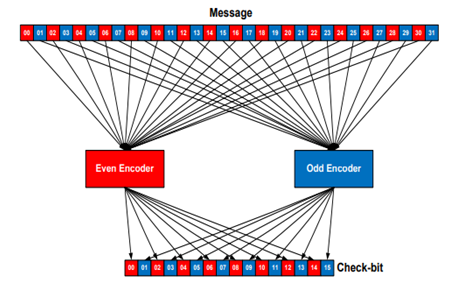
In this paper, we present two interleaved Double-Adjacent-Error Corrections (DAECs) for Error Detection and Correction (EDAC), using the Hsiao Code and Cyclic Redundancy Code (CRC).
Abstract
A radiation-induced single-event upset (SEU) is
a major disruption to electronics operating in satellites. If not rectified, a
single-bit-error can become uncorrectable. In this paper, we present two
interleaved Double-Adjacent-ErrorCorrections (DAECs) for Error Detection and
Correction (EDAC), using the Hsiao Code and Cyclic Redundancy Code (CRC). From
our results, both EDACs can correct 100% of the single-bit-errors,
double-adjacent-bit-errors, and detect doublebit-errors and up to
four-adjacent-bit-errors. The Hsiao Code EDAC encoder design requires less
bit-weight than the CRC EDAC, which is an attribute of a high-speed EDAC. The
CRC EDAC, in contrast, has a higher error detection rate for both three- and
four-bit-errors. We also propose two storage formats and algorithm designs that
can manage and store the 48-bit codeword in 8-bit and 16-bit memory devices, a
typical satellite scenario where board space is scarce.
NOTE: Without the concern of our team, please don't submit to the college. This Abstract varies based on student requirements.
Block Diagram
Specifications
Software Requirements:
- Xilinx Vivado Tool
- HDL: Verilog
Hardware Requirements:
- Microsoft® Windows XP
- Intel® Pentium® 4 processor or Pentium 4 equivalent with SSE support
- 512 MB RAM
- 100 MB of available disk space
Learning Outcomes
- Basics of Digital Electronics
- VLSI design Flow
- Introduction to Verilog Coding
- Different modeling styles in Verilog
- Data Flow modeling
- Structural modeling
- Behavioral modeling
- Mixed level modeling
- Introduction to error correction design
- About CRC
- Knowledge on Hsaio code
- Knowledge on error detection
- About interleaving concept
- Applications in real time
- Xilinx ISE 14.7/Xilinx Vivado for design and simulation
- Generation of Netlist
- Solution providing for real time problems
- Project Development Skills:
- Problem Analysis Skills
- Problem Solving Skills
- Logical Skills
- Designing Skills
- Testing Skills
- Debugging Skills
- Presentation Skills
- Thesis Writing Skills


Related Topics
 Paper Publishing

Request Call Back
Would you like to receive a free callback now?
Choose the best time for callback:
Leave your message and we will contact you as soon as possible

6-2-85/B, Old Maternity Hospital Road, Thyagaraja Nagar, Tirupati, Andhra Pradesh – 517501
+91 9030333433
+91 9393939065
0877-2261612

Disclaimer - Takeoff Edu Group Projects are not associated or affiliated with IEEE in any way. The IEEE Projects mentioned here are mentioned in the context of student projects, whose ideas are derived from IEEE publications, not projects of or by IEEE.

