Design of Reversible MAC Unit, Shift and Add Multiplier using PSDRM Technique
Objective
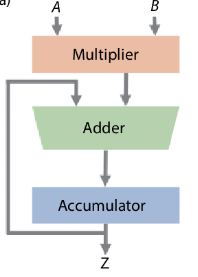
The design of an Error Tolerant (ET) Shift-and Add Multiplier is done. It utilizes the concept of error tolerant addition for accumulation of partial products and a ring counter for shifting of multiplier bits and partial product.
Abstract
Reversible logic has become very
promising for low power design using emerging computing
technologies. Sequential circuits can
be built by replacing the latches, flip-flops and associated
combinational gates of the traditional
irreversible designs by their reversible counter parts. Since it leads to high
quantum cost and garbage outputs this replacement technique is not very
promising. It is possible to design synchronous sequential circuits directly
from reversible gates using pseudo Reed– Muller expressions representing the
state transition and the output functions of the circuit. The multiplication and
accumulation (MAC) are the important operations involved in almost all the
Digital Signal Processing applications. Accumulator in this MAC unit will be
designed using PSDRM technique. And
Multiplier is the fundamental components of many digital and non digital
systems and hence, their power dissipation is the prime concern. The design of
an Error Tolerant (ET) Shift-and Add Multiplier is done. It utilizes the
concept
of error tolerant addition for
accumulation of partial products and a ring counter for shifting of multiplier bits
and partial product. Shift register used to shift multiplier bits and partial
product is designed using Pseudo Reed Muller expression.
NOTE: Without the concern of our team, please don't submit to the college. This Abstract varies based on student requirements.
Block Diagram
Specifications
Hardware requirement
Processor - Pentium –III
Speed - 1.1 GHz
RAM - 1 GB (min)
Hard Disk - 40 GB
Floppy Drive - 1.44 MB
Key Board - Standard Windows Keyboard
Mouse - Two or Three Button Mouse
Monitor - SVGA
Software requirements
v Operating System :Windows95/98/2000/XP/Windows7
v Front End : Modalism 6.3 for Debugging and Xilinx 14.3 for Synthesis and Hard Ware Implementation
v This software’s where Verilog source code can be used for design implementation.
Learning Outcomes
Understanding Reversible Logic: Gain a thorough understanding of reversible logic gates and circuits, including the principles and advantages of reversible computation.
Reversible MAC Unit Design: Acquire knowledge and skills related to the design of a reversible MAC unit, which performs the multiplication and accumulation of operands in a reversible manner.
Shift and Add Multiplier Design: Learn the principles and techniques for designing a shift and add multiplier, which is a common method for implementing multiplication operations.
Familiarity with PSDRM Technique: Become familiar with the PSDRM technique, which is a specific approach to designing reversible logic circuits using the concepts of self-duality and Reed-Muller expansions.
Implementation of Reversible Circuits: Gain hands-on experience in implementing the designed reversible MAC unit and shift and add multiplier using the PSDRM technique, using a hardware description language (HDL) or a logic synthesis tool.
Reversible Circuit Optimization: Explore various optimization techniques for reversible logic circuits, such as gate count reduction, quantum cost minimization, and power optimization, to improve the performance and efficiency of the designed circuits.
Analysis and Evaluation: Learn how to analyze and evaluate the performance metrics of the designed circuits, such as gate count, circuit delay, power consumption, and area utilization, and assess their suitability for specific applications.
Problem-Solving Skills: Enhance problem-solving skills by addressing challenges and complexities associated with the design of reversible MAC units and shift and add multipliers, including trade-offs between circuit complexity, performance, and efficiency.
Research and Literature Review: Develop the ability to conduct research and review relevant literature on reversible logic, MAC units, shift and add multipliers, and the PSDRM technique, to stay updated with the latest advancements in the field.
Communication and Documentation: Practice effective communication and documentation skills by presenting the design methodology, results, and findings of the reversible MAC unit and shift and add multiplier using the PSDRM technique in a clear and concise manner, both orally and in written reports or papers.


 Paper Publishing

Request Call Back
Would you like to receive a free callback now?
Choose the best time for callback:
Leave your message and we will contact you as soon as possible

6-2-85/B, Old Maternity Hospital Road, Thyagaraja Nagar, Tirupati, Andhra Pradesh – 517501
+91 9030333433
+91 9393939065
0877-2261612

Disclaimer - Takeoff Edu Group Projects are not associated or affiliated with IEEE in any way. The IEEE Projects mentioned here are mentioned in the context of student projects, whose ideas are derived from IEEE publications, not projects of or by IEEE.

