Design of Reconfigurable Cache Memory Using Verilog HDL
Objective
To design and implement a reconfigurable cache memory system using Verilog HDL that adapts dynamically to varying application demands in terms of size, associativity, and replacement policies. The project aims to improve system performance, power efficiency, and memory utilization by allowing the cache architecture to be customized based on runtime requirements. The design will be simulated and verified for correctness, latency, and scalability using HDL simulation tools.
Abstract
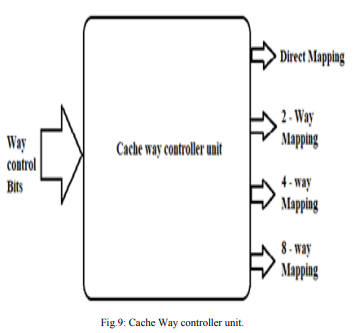
Cache memory serves as a high-speed storage layer that bridges the performance gap between fast processors and slower main memory. The design and implementation of a 64-bit reconfigurable 2-way set associative cache memory in Verilog HDL extends an 8-bit model to enhance data handling and overall performance. Utilizing 2-way set associativity, the cache balances direct-mapped and fully associative approaches, reducing conflict misses and improving access speed. Reconfigurable features enable adjustments in cache size, block size, and associativity, allowing for adaptability to various performance requirements
NOTE: Without the concern of our team, please don't submit to the college. This Abstract varies based on student requirements.
Block Diagram
Specifications
Software Requirements:
· Xilinx VIVADO.
Hardware Requirements:
· Digilent Basys-3 if Required.
Learning Outcomes
· Verilog HDL concepts.
1. Behavioural modelling.
2. Always block.
3. Case statements.
4. Casex statements.
5. Data-flow modelling.
6. Assign statements.
7. Simple digital electronics concepts.
Demo Video


Request for Video
 Paper Publishing
Request Call Back
Would you like to receive a free callback now?
Choose the best time for callback:
Leave your message and we will contact you as soon as possible

6-2-85/B, Old Maternity Hospital Road, Thyagaraja Nagar, Tirupati, Andhra Pradesh – 517501
+91 9030333433
+91 9393939065
0877-2261612

Disclaimer - Takeoff Edu Group Projects are not associated or affiliated with IEEE in any way. The IEEE Projects mentioned here are mentioned in the context of student projects, whose ideas are derived from IEEE publications, not projects of or by IEEE.

