Design of Low Power and High-Speed MAC Unit for Digital Signal Processing Applications
Objective
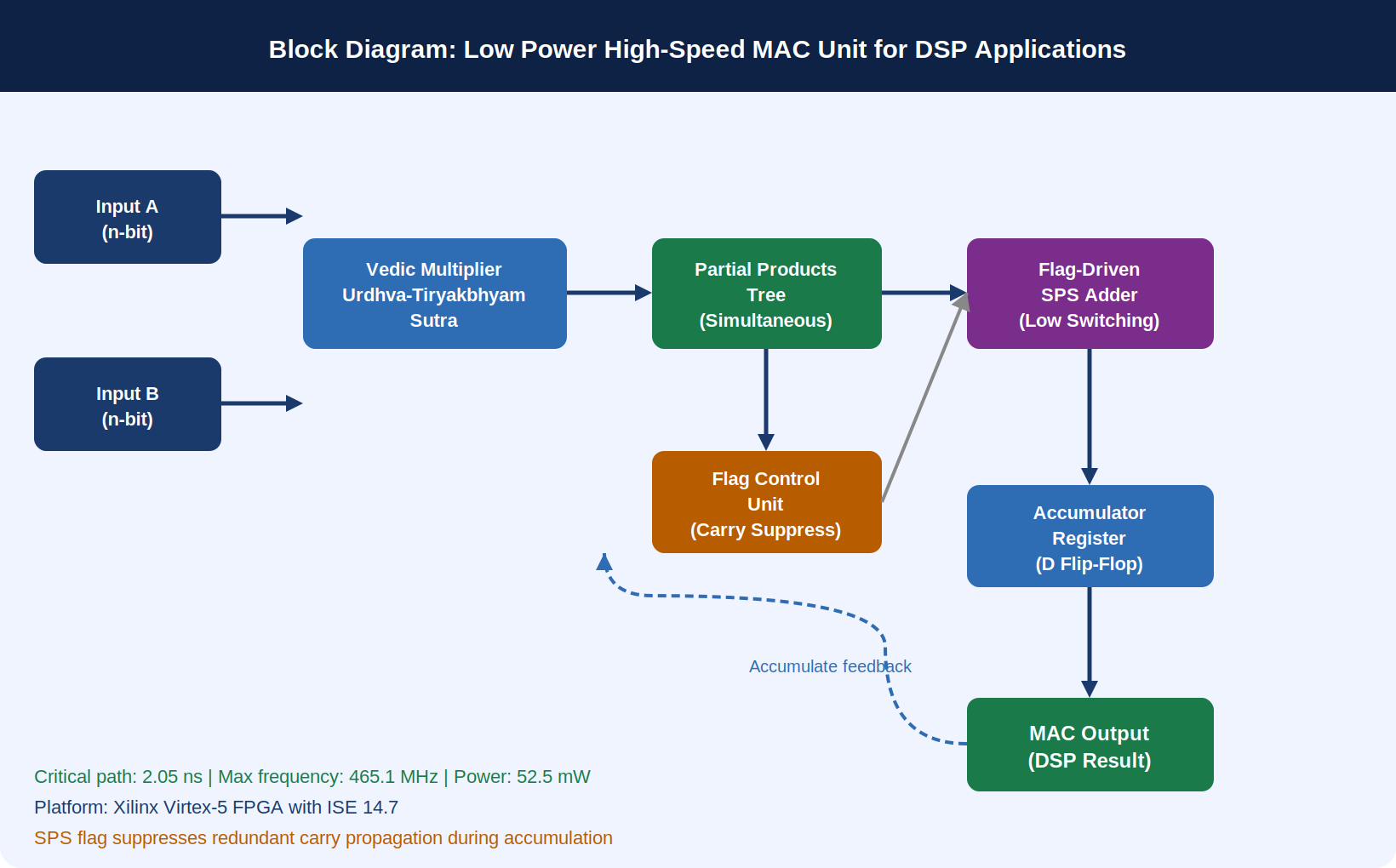
The Multiply-Accumulate (MAC) unit is a fundamental computational block in Digital Signal Processing architectures, critical for filtering, convolution, FFT, and neural network inference. Performance of the MAC unit in terms of speed and power directly determines the efficiency of the overall DSP system. This paper presents a low-power, high-speed MAC unit targeting DSP applications using a Vedic mathematics-based Urdhva-Tiryakbhyam multiplier integrated with a flag-driven Selective Partial Sum (SPS) adder that suppresses redundant carry propagation and minimizes switching activity
Abstract
The Multiply-Accumulate (MAC) unit is a fundamental computational block in Digital Signal Processing architectures, critical for filtering, convolution, FFT, and neural network inference. Performance of the MAC unit in terms of speed and power directly determines the efficiency of the overall DSP system. This paper presents a low-power, high-speed MAC unit targeting DSP applications using a Vedic mathematics-based Urdhva-Tiryakbhyam multiplier integrated with a flag-driven Selective Partial Sum (SPS) adder that suppresses redundant carry propagation and minimizes switching activity. Implemented in Verilog HDL and synthesized on a FPGA using Xilinx vivado , significantly outperforming conventional MAC architectures.
Keywords: MAC Unit, Multiply-Accumulate, Low Power, High Speed, DSP, Vedic Multiplier, FPGA, Urdhva-Tiryakbhyam
NOTE: Without the concern of our team, please don't submit to the college. This Abstract varies based on student requirements.
Block Diagram
Specifications
Software Requirements
• Xilinx Vivado
• Verilog HDL / VHDL
Hardware Requirements
• Xilinx FPGA (Basys-3 / Nexys A7)
• Oscilloscope
• Logic Analyzer
Learning Outcomes
• MAC Architecture Design and Optimization
• Vedic Multiplier Implementation
• Low Power Adder Design Techniques
• FPGA-Based DSP System Development
• High-Speed Arithmetic for Signal Processing


 Paper Publishing

Request Call Back
Would you like to receive a free callback now?
Choose the best time for callback:
Leave your message and we will contact you as soon as possible

6-2-85/B, Old Maternity Hospital Road, Thyagaraja Nagar, Tirupati, Andhra Pradesh – 517501
+91 9030333433
+91 9393939065
0877-2261612

Disclaimer - Takeoff Edu Group Projects are not associated or affiliated with IEEE in any way. The IEEE Projects mentioned here are mentioned in the context of student projects, whose ideas are derived from IEEE publications, not projects of or by IEEE.

