Design of generic vedic ALU using reversible logic
Also Available Domains Arithmetic Core
Objective
The objective of this work is to design a generic Arithmetic Logic Unit (ALU) based on Vedic mathematics and implemented using reversible logic to achieve low power consumption, reduced circuit complexity, and high computational efficiency. The design focuses on combining Vedic arithmetic techniques with reversible logic gates to minimize energy dissipation and improve the speed and scalability of arithmetic operations in future low-power and quantum computing systems.
Abstract
Abstract
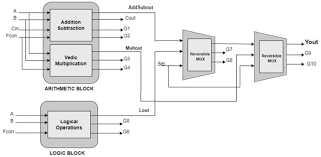
This paper details the design and implementation of a low-power Generic Arithmetic Logic Unit (ALU) based on Vedic mathematics principles, constructed using reversible logic gates and implemented on an Artix-7 Field-Programmable Gate Array (FPGA).The Vedic mathematics principles are employed to derive efficient computational methods, and reversible logic is harnessed to achieve minimal power dissipation and reduced heat generation in the ALU. The proposed ALU architecture is optimized to perform fundamental arithmetic operations: addition, subtraction, multiplication, and division; as well as bitwise logical operations: AND, OR, and XOR. Vedic mathematics techniques contribute to the reduction of critical paths and garbage outputs, enhancing the overall performance of the ALU. The design is synthesized and implemented on a device Xc7a35tcpg236 belonging to Artix-7 family of FPGA, and power consumption is evaluated and compared with conventional ALU designs. Performance parameters, including power consumption and delay, were benchmarked against existing designs. The designed ALU operates at a clock frequency of 408.197 MHz, featuring a maximum combinational path delay of 4.65 ns with input voltage of 1 V. Notable is its power efficiency, which consumes a mere 42 mW, as opposed to the conventional ALU with a power consumption of 73 mW. The Vinculum based logic of reducing bigger number to smaller ones thereby simplifying calculations is also added in the design. Incorporating Vedic reversible logic with vinculum in FPGA design introduces a novel approach leveraging parallelism and pipelining for enhanced efficiency and performance. Furthermore, the FPGA-based implementation showcases the scalability of the design for higher bit-width ALUs, highlighting its potential for integration into complex digital systems. The proposed Generic low-power Vedic ALU using reversible logic opens up new opportunities for energy-efficient computing applications, such as portable devices, embedded systems, and Internet of Things (IoT) devices. The fusion of Vedic mathematics with reversible logic offers a novel approach to design efficient ALUs, contributing to the advancement of low-power and high-performance digital circuitry.Keywords
Artix-7 FPGALow powerGeneric vedic ALUReversible logicVedic mathematicsUrdhva-Tiryagbhyam reversible logic gatesNOTE: Without the concern of our team, please don't submit to the college. This Abstract varies based on student requirements.
Block Diagram
Specifications
Software Requirements:
VIVADO 2018.3
Hardware Requirements:
· Microsoft® Windows XP
· Intel® Pentium® 4 processor or Pentium 4 equivalent with SSE support
· 512 MB RAM
· 100 MB of available disk space
Learning Outcomes
- Basics of Digital Electronics
- VLSI design Flow
- Applications in real time
· VIVADO for design and simulation
· Solution providing for real time problems
· Project Development Skills:
o Problem Analysis Skills
o Problem Solving Skills
o Logical Skills
o Designing Skills
o Testing Skills
o Debugging Skills
o Presentation Skills
o Thesis Writing Skills


 Paper Publishing

Request Call Back
Would you like to receive a free callback now?
Choose the best time for callback:
Leave your message and we will contact you as soon as possible

6-2-85/B, Old Maternity Hospital Road, Thyagaraja Nagar, Tirupati, Andhra Pradesh – 517501
+91 9030333433
+91 9393939065
0877-2261612

Disclaimer - Takeoff Edu Group Projects are not associated or affiliated with IEEE in any way. The IEEE Projects mentioned here are mentioned in the context of student projects, whose ideas are derived from IEEE publications, not projects of or by IEEE.

