Design of energy efficient VCO for PLL application
Also Available Domains Transistor Logic|Low Power VLSI
Objective
To design an energy-efficient voltage-controlled oscillator (VCO) optimized for phase-locked loop (PLL) applications. To achieve low phase noise, wide tuning range, and minimal power consumption while maintaining frequency stability and fast lock performance
Abstract
Phase-Locked Loops (PLLs) are essential in many communication systems (GPS, satellite, frequency synthesizer, clock data recovery). The Voltage-Controlled Oscillator (VCO) is a critical block in PLLs.
There is a need for VCOs to not only deliver sufficiently high frequency and wide tuning range but also to be energy/power efficient (i.e. low switching energy).
NOTE: Without the concern of our team, please don't submit to the college. This Abstract varies based on student requirements.
Block Diagram
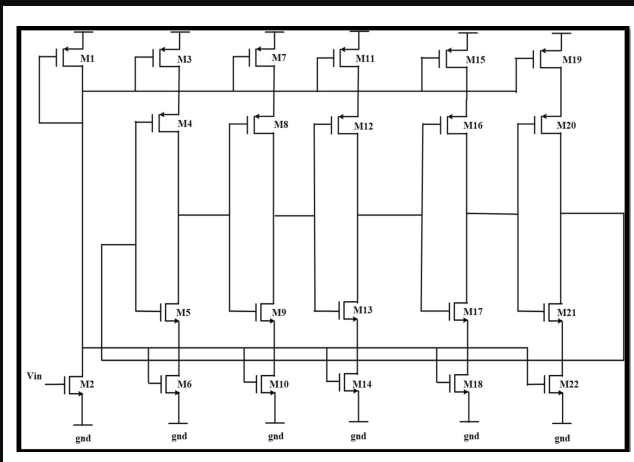
Specifications
Software Requirements:
- Tool: Cadence Virtuoso
- Technology: GPDK 45nm&90nm
Hardware Requirements:
- Microsoft® Windows XP
- Intel® Pentium® 4 processor or Pentium 4 equivalent with SSE support
- 512 MB RAM
- 100 MB of available disk space
Learning Outcomes
Trade-off considerations in VCO/PLL design for low power / high performance
-
Recognize that improvements in one metric (e.g., frequency) may cost in another (e.g., area, stability, phase noise). While the paper focuses on frequency and switching energy, one must consider what is not improved or whether there are costs (e.g., complexity, noise).
-
Understand the role of process scaling (e.g. 45 nm CMOS) in enabling lower energy per switch, etc.
Use of simulation tools and design flow
-
Gain hands-on understanding of using cad tools (Cadence Virtuoso) for analog circuit design and simulation in nanoscale CMOS.
-
Learn what kinds of simulations are needed (e.g. transient, switching energy, frequency tuning) to validate VCO behavior under various control voltages / configurations. Implicit from design methodology


Related Projects
 Paper Publishing

Request Call Back
Would you like to receive a free callback now?
Choose the best time for callback:
Leave your message and we will contact you as soon as possible

6-2-85/B, Old Maternity Hospital Road, Thyagaraja Nagar, Tirupati, Andhra Pradesh – 517501
+91 9030333433
+91 9393939065
0877-2261612

Disclaimer - Takeoff Edu Group Projects are not associated or affiliated with IEEE in any way. The IEEE Projects mentioned here are mentioned in the context of student projects, whose ideas are derived from IEEE publications, not projects of or by IEEE.

