Design of Approximate Radix-4 Booth Multipliers for Error-tolerant Computing
Also Available Domains Arithmetic Core|Xilinx ISE
Objective
To achieve low power, high performance in terms of delay are achieved by using Approximate computing design methodology and can reduce the circuit complexity by relaxing the requirement of accuracy.
Abstract
Abstract:
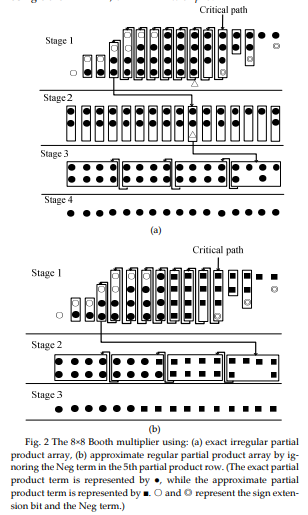
To achieve low power, high performance in terms of delay are achieved by using Approximate computing design methodology and can reduce the circuit complexity by relaxing the requirement of accuracy. In this paper, approximate Booth multipliers are designed based on approximate radix-4 modified Booth encoding (MBE) algorithms and a regular partial product array that employs an approximate Wallace tree. Two approximate Booth encoders are proposed and analyzed for error-tolerant computing. The error characteristics are analyzed with respect to the so-called approximation factor that is related to the inexact bit width of the Booth multipliers. The results show that the proposed 16-bit approximate radix-4 Booth multipliers with approximate factors of 12 and 14 are more accurate than existing approximate Booth multipliers with moderate power consumption. The proposed R4ABM2 multiplier with an approximation factor of 14 is the most efficient design when considering both power-delay product and the error metric NMED. Case studies for image processing show the validity of the proposed approximate radix-4 Booth multipliers.
NOTE: Without the concern of our team, please don't submit to the college. This Abstract varies based on student requirements.
Block Diagram
Specifications
Tools and Coding Languages we use:
v Front End : Xilinx ISE 14.7 for Synthesis, Simulation and Implementation
v This software’s where Verilog source code can be used for design implementation.
Learning Outcomes
Learning outcomes:
· Understanding of radix-4 Booth encoding
· Knowledge of approximate computing
· Familiarity with error-tolerant computing
· Understanding of multiplier architectures
· Analysis of error characteristics
· Design optimization techniques
· Communication and presentation skills


 Paper Publishing

Request Call Back
Would you like to receive a free callback now?
Choose the best time for callback:
Leave your message and we will contact you as soon as possible

6-2-85/B, Old Maternity Hospital Road, Thyagaraja Nagar, Tirupati, Andhra Pradesh – 517501
+91 9030333433
+91 9393939065
0877-2261612

Disclaimer - Takeoff Edu Group Projects are not associated or affiliated with IEEE in any way. The IEEE Projects mentioned here are mentioned in the context of student projects, whose ideas are derived from IEEE publications, not projects of or by IEEE.

