Design of a Multi-Sensors Wearable System for Continuous Home Monitoring of People With Parkinson’s
Objective
The objective of this study is to design a wearable multi-sensor system for continuous home monitoring of individuals with Parkinson's disease. The system aims to track and analyze physiological and movement data to support early detection and personalized disease management.
Abstract
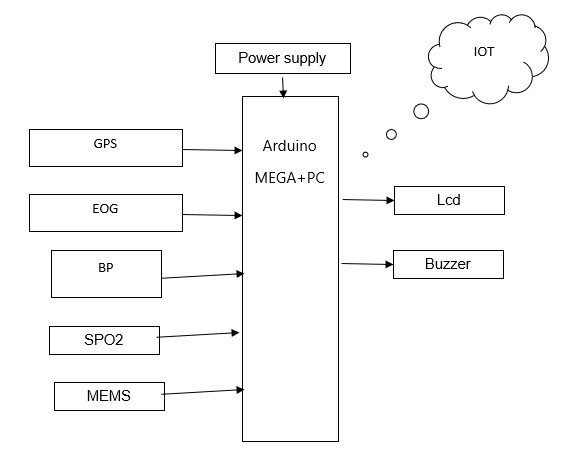
Parkinson’s disease (PD) is a progressive neurological disorder that impairs motor control, balance, and cognitive function. Continuous monitoring of individuals with PD at home can help identify abnormal events at an early stage, reduce complications, and improve overall quality of life. This project proposes a multi-sensor wearable system for real-time monitoring of Parkinson’s patients. The system is built around an Arduino Mega and integrates multiple sensors, including a MEMS-based blood pressure (BP) sensor for BP measurement and fall detection, a pulse oximeter (SpO₂) for monitoring oxygen saturation, and an electrooculography (EOG) sensor for analyzing eye movements, currently at the demonstration stage. Sensor data are stored locally and processed using machine learning techniques to detect irregularities in vital signs and movement patterns. When a critical condition is detected, a buzzer provides an audible alert and an automated email notification, including GPS location, is sent to caregivers or medical personnel. All collected data are uploaded to an IoT platform using Python. The proposed system provides a cost-effective and real-time solution for remote monitoring of Parkinson’s patients, enabling timely intervention and improving patient safety.
Keywords:
· Parkinson’s Disease
· Multi-Sensor Wearable System
· MEMS Accelerometer
· Cloud Monitoring
· Home Healthcare
· Continuous Health Monitoring
NOTE: Without the concern of our team, please don't submit to the college. This Abstract varies based on student requirements.
Block Diagram
Specifications
Hardware components:
- Arduino Mega
- MEMS Blood Pressure (BP) Sensor
- Pulse Oximeter (SPO2) Sensor
- Electrooculography (EOG) Sensor (Demo Stage)
- Bio-Amplifier Module
- Local Storage
- GPS
- Buzzer
- Power Supply
- Connecting Wires
Software components:
- Arduino ide
- Python
Learning Outcomes
- Arduino pin diagram and architecture
- Introduction to Arduino IDE
- Basic of Embedded C language
- Working of power supply
- About Project Development Life Cycle:
- Planning and Requirement Gathering( software’s, Tools, Hardware components, etc.,)
- Schematic preparation
- Code development and debugging
- Hardware development and debugging
- Development of the Project and Output testing
- Practical exposure to:
- Hardware and software tools.
- Solution providing for real time problems.
- Working with team/ individual.
- Work on Creative ideas.
- Project development Skills
- Problem analyzing skills
- Problem solving skills
- Creativity and imaginary skills
- Programming skills
- Deployment
- Testing skills
- Debugging skills
- Project presentation skills
Demo Video


Request for Video
 Paper Publishing
Request Call Back
Would you like to receive a free callback now?
Choose the best time for callback:
Leave your message and we will contact you as soon as possible

6-2-85/B, Old Maternity Hospital Road, Thyagaraja Nagar, Tirupati, Andhra Pradesh – 517501
+91 9030333433
+91 9393939065
0877-2261612

Disclaimer - Takeoff Edu Group Projects are not associated or affiliated with IEEE in any way. The IEEE Projects mentioned here are mentioned in the context of student projects, whose ideas are derived from IEEE publications, not projects of or by IEEE.

