Design and Verification of Floating Point Multiplier for DSP Applications
Objective
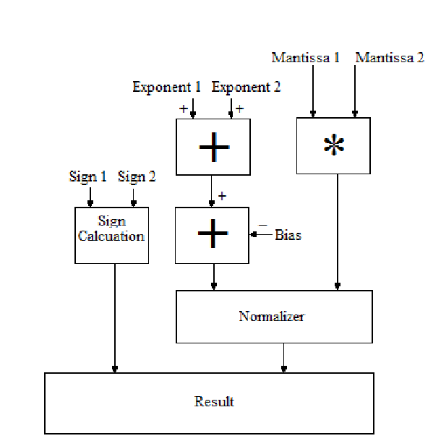
This paper presents the design, functional verification, and synthesis-level evaluation of a pipelined IEEE-754 single-precision floating-point multiplier, optimized for real-time digital signal processing (DSP) applications. Unlike most existing FPGA-based floating-point multipliers, the proposed design integrates a simplified Dadda-based mantissa multiplier with a carry look-ahead adder for exponent computation, supports all four IEEE-754 rounding modes, and provides complete exception handling for overflow, underflow, invalid, and inexact results
Abstract
NOTE: Without the concern of our team, please don't submit to the college. This Abstract varies based on student requirements.
Block Diagram
Specifications
Specifications:
Software Requirements:
· VIVADO 2018.3 & Matlab
Hardware Requirements:
· Microsoft® Windows XP
· Intel® Pentium® 4 processor or Pentium 4 equivalent with SSE support
· 512 MB RAM
· 100 MB of available disk space
Learning Outcomes
- Understanding of IEEE-754 floating-point representation and operations
- Knowledge of pipelined architecture design for high-speed computation
- Implementation of Dadda multiplier and carry look-ahead adder
- Handling of special floating-point cases (NaN, infinity, subnormal numbers)
- Experience with Verilog HDL design and self-checking testbenches
- Skills in FPGA synthesis and timing optimization using Xilinx Vivado
- Insight into performance vs. resource trade-offs in digital design.


Related Projects
 Paper Publishing

Request Call Back
Would you like to receive a free callback now?
Choose the best time for callback:
Leave your message and we will contact you as soon as possible

6-2-85/B, Old Maternity Hospital Road, Thyagaraja Nagar, Tirupati, Andhra Pradesh – 517501
+91 9030333433
+91 9393939065
0877-2261612

Disclaimer - Takeoff Edu Group Projects are not associated or affiliated with IEEE in any way. The IEEE Projects mentioned here are mentioned in the context of student projects, whose ideas are derived from IEEE publications, not projects of or by IEEE.

