Design and Verification of APB Protocol
Objective
The AMBA protocol comprises the Advanced Peripheral Bus (APB) component, designed for low-power, efficient communication between microprocessors and peripherals in mainstream System-on-Chip (SoC) designs. Its strength lies in simplicity, integration convenience, and low-latency communication making it the right choice for energy-sensitive applications
Abstract
Abstract: The AMBA protocol comprises the Advanced Peripheral Bus (APB) component, designed for low-power, efficient communication between microprocessors and peripherals in mainstream System-on-Chip (SoC) designs. Its strength lies in simplicity, integration convenience, and low-latency communication making it the right choice for energy-sensitive applications. Therefore, in this paper, the design and verification of the APB protocol have been discussed based on a Finite State Machine (FSM) model to give a broad overview of the various phases of operation of the standard and a structured implementation. Verification is completed using UVM to thoroughly check the functional and timing aspects of APB-based verification.
Keywords: - Advanced Peripheral Bus (APB), Finite State Machine (FSM), UVM (Universal Verification Methodology).
NOTE: Without the concern of our team, please don't submit to the college. This Abstract varies based on student requirements.
Block Diagram
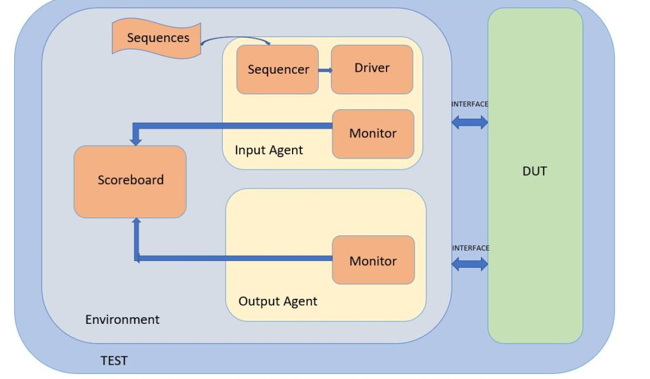
Specifications
Software Requirements:
· Xilinx Vivado Tool
· HDL: Verilog
· Questa Sim Tool
Hardware Requirements:
· Microsoft® Windows XP,
· Intel® Pentium® 4 processor or Pentium 4 equivalent with SSE support
· 512 MB RAM
· 100 MB of available disk space
Learning Outcomes
- Understand APB Architecture
- Analyze APB Transactions
- Identify Limitations of Existing Methods
- Apply UVM Methodology
- Design Reusable Verification Components
Demo Video


Request for Video
 Paper Publishing
Request Call Back
Would you like to receive a free callback now?
Choose the best time for callback:
Leave your message and we will contact you as soon as possible

6-2-85/B, Old Maternity Hospital Road, Thyagaraja Nagar, Tirupati, Andhra Pradesh – 517501
+91 9030333433
+91 9393939065
0877-2261612

Disclaimer - Takeoff Edu Group Projects are not associated or affiliated with IEEE in any way. The IEEE Projects mentioned here are mentioned in the context of student projects, whose ideas are derived from IEEE publications, not projects of or by IEEE.

